What if My Child is the Bully?

by Collett Smart

What if my Child is the Bully

Nothing stirs the heart of a parent more than bullying. I don’t think there is a week that goes by without a story in the media about a child being bullied. I sat with another parent in pain, just this week. She told me about her daughter’s anguish at being bullied.

The mother found out about it one night, when she and her partner heard their daughter quietly sobbing after lights out. In desperation, her daughter finally asked her dad, “What would you do if someone threw stuff at you everyday?” Her daughter had endured days of having bottles, pebbles and other paraphernalia thrown at her during break times. There was the usual ringleader, the sidekicks and the the bystanders.


Bullying has terrible effects on the victims involved, but one of the toughest things to process, as a parent, is the question, “What if my child is the bully?” What happens when you get a call from your child’s school and hear the words, “I’m afraid that your child has been bullying someone in their class. Please could you come in for a meeting?” Let’s assume that there has been no misunderstanding and this is not just a one-off mean incident or disagreement between friends.   The definition of bullying, supplied by The National Centre Against Bullying

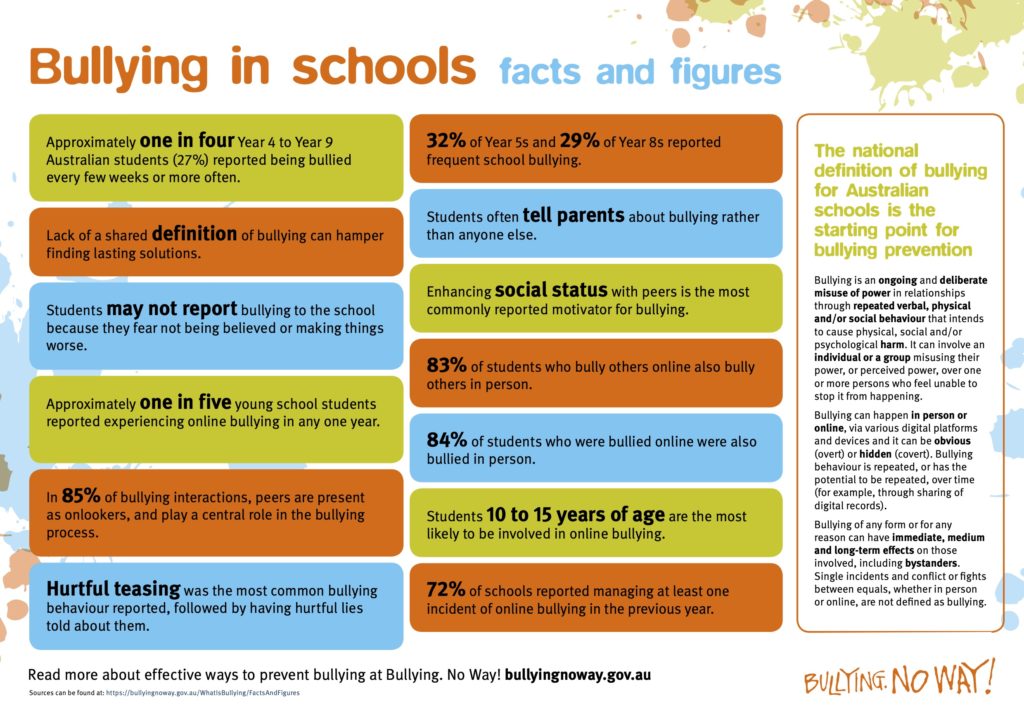
“Bullying is an ongoing and deliberate misuse of power in relationships through repeated verbal, physical and/or social behaviour that intends to cause physical, social and/or psychological harm. It can involve an individual or a group misusing their power, or perceived power, over one or more persons who feel unable to stop it from happening.
Bullying can happen in person or online, via various digital platforms and devices and it can be obvious (overt) or hidden (covert). Bullying behaviour is repeated, or has the potential to be repeated, over time (for example, through sharing of digital records).
Bullying of any form or for any reason can have immediate, medium and long-term effects on those involved, including bystanders.
Single incidents and conflict or fights between equals, whether in person or online, are not defined as bullying.”


Facts and Figures by Bullying No Way:


Start by taking a deeper look at the reasons for their behaviour

There are many reasons a child might bully others:


  • Peer pressure – where another child is the ‘chief bully’ and your child feels they must join in to maintain the friendship and be accepted.
  • Unhealthy self-preservation – your teen might have been a victim of bullying themselves and decides to choose to be a bully in an unhealthy form of self-preservation. Or your teen may fear the bully turning on them, so joins in the bullying behaviour to direct attention away from themselves.
  • Poor anger management skills – e.g. when your teen hasn’t learned to control their emotions well and chooses a few of the same people to take their anger out on, when things don’t go their way (using either verbal or physical aggression to deal with conflict).
  • Poor impulse control – e.g. might regularly lash out at the same kids in sport and games and is often an arrogant winner or a sore loser.
  • For social status (and power) – some young people use fear or intimidation to try to be the most popular in an unhealthy peer group.
  • Poor self-worth – when a young person pulls others down, out of envy or unhealthy comparison/ competition.
  • Lacking empathy – for others who are different to themselves,
  • Something they have learned in the family, through observing the way a parent or older sibling treats family members or work colleagues. (Note: this is often assumed to be the main issue behind bullying, but is certainly not always the case. I have seen children in stable families who choose to engage in bullying behaviour for a period of time. Simplistically blaming parenting can lead adults to overlook underlying issues in the child. Which is why we must look into the many areas.)
  • A combination of any of the above.


What can you do to help your tween or teen move forward in healthier ways?

1.      Stay calm and take time to process the information yourself.

2.     Address the bullying behaviour directly. Explain the facts of what you have been told. Express that hurting another person is never okay, and that hurting is not part of your family values. This demonstrates your awareness of the situation and that bullying is not acceptable in your family.

3.     Avoid shaming your child and look for a pattern. Communicate that they can talk to you about their own insecurities and fears. Take time to find out the underlying need for their behaviour (as above).

4.     Don’t make excuses for your teen’s behaviour. Remind your child that bullying is a choice and they can choose to stop. Talk about the different forms of bullying (emotional, physical and psychological, and be sure to include the online forms).

5.     Talk about the effects on the victim/s. Help your tween to acknowledge their responsibility and recognise exactly what it is they have done or caused. Where appropriate, help your tween draft an apology to the victim. (Be aware that some children might not be good at taking responsibility for their own actions and initially blame others for their behaviour.)

6.     Set age-appropriate consequences for their behaviour, support the school’s plan for natural consequences and check in regularly to track your child’s progress.

7.     If your teenager is both a bully and a victim, help them make a decision to stop their own behaviour but develop skills to deal with being bullied themselves. (Ask who they might talk to at school and home, if they are being bullied.)

8.     Be a role model. Over the next few months, connect with your teen and talk often about healthy friendships and what being a kind human looks like (use memes, movies and stories to help you).

9.     Help your child to develop new skills and explore hanging out with new groups that might improve their sense of worth and develop healthy social skills (e.g. sport, arts, activities, community youth groups, family friends etc).

10.     Obtain the assistance of a mentor, a coach or a counsellor in teaching your child to practice new social and emotional skills.  Your GP or school counsellor will have the contact details of professionals in your area.


One last thought

Our teens are still works in progress (actually so are we). While bullies most certainly need to face natural consequences for their choices and behaviours, we need to also provide them with support and access to tools which will help them to make healthier choices going forward. Adults who are bullies, didn’t become like that overnight.

Remember my parenting mantra? – “Parent with your child’s future adult in mind.”


Collett Smart is a psychologist, qualified teacher, speaker and internationally published author of, ‘They’ll be Okay: 15 Conversations to help your child through troubled times’. The heart of Collett’s work is to support and bring Hope to parents of tweens and teens. She lives with her husband and 3 children in Sydney, Australia. Find out more at www.raisingteenagers.com.au

Talking about vaping, alcohol & other drugs

By Collett Smart
What is the secret to raising healthy teenagers?


On vaping, alcohol and other drugs

Paul Dillon is my go-to expert on all things drug and alcohol related. I don’t usually write or speak about this topic without referring to his work. Despite his topic, Paul is hopeful about young people and provides very practical support.

Alcohol


What do we know about teen alcohol consumption?

In Season 1 Ep 9 of the podcast, I covered alcohol, parties and binge drinking, and refer to information from my previous blog post where I discuss the effects of binge drinking. Yet, research encouragingly, indicates, overall fewer teens are choosing to drink.

There is great debate about the reasons, but one of the reasons we know about is the reduction in parental supply (see reports here and here). For example, parents have become more aware of the detrimental effects of alcohol on the developing brain. (Listen out for Paul’s story in my interview with him on this week’s episode, about the change in parents’ response over the years, to his seminars on alcohol.)


The risks


The concern is for teens who do drink heavily, as they are binge drinking at dangerous levels.  We know that alcohol lowers inhibitions and when paired with an underdeveloped brain, it is more likely for teenagers to make risky decisions.

One factor Paul highlights is that, for some, parents are one of the main suppliers of alcohol to teenage drinkers. This comes from a long-standing myth, that providing a teenager with alcohol will help their child to drink ‘more responsibly’, and that because they are ‘under supervision’ teens will then make better drinking choices when going out. However, the research tells us that this in fact has the opposite effect. Teens who are supplied alcohol at home, tend to go on and drink higher quantities of alcohol when out.

FARE – the Foundation for Alcohol Research & Education’s indicates,

“In Australia, almost 60 per cent of alcohol consumed by 12-to-17 year-olds is supplied by adult friends, relatives or strangers, despite the fact that the provision of alcohol to young people under the age of 18 by someone other than their parent or guardian is in fact illegal in most Australian jurisdictions.”


Vaping

For many years, we’ve seen a downward trend in smoking. i.e., people are smoking less. The community got behind the issue and saw smoking as something that not only harmed the individual but also harmed other people.

Vaping then, is the topic on every school principal’s mind right now. Paul Dillon tells me that we have not seen this kind of drug related issue come back on school grounds since the early 80s, with kids both vaping and selling vapes at school. He mentions how easy they are to get online, through social media. But not every kid is vaping.


What is vaping?

From Paul’s website:
Vaping is the act of inhaling and exhaling an aerosol (referred to as a vapour), which is produced by an e-cigarette. An aerosol is a mixture of ultrafine liquid particles that can contain a range of chemicals. (Darta – vaping fact sheet)

In this fact sheet for parents, Paul provides definitions, as well as information on what we know and don’t know about vaping currently. Paul does warn, that just because we can’t yet ‘prove’ the long-term negative effects of vaping, that doesn’t mean there aren’t any. We thought the same about smoking decades ago.


Is vaping ‘safe’?

From one of his fact sheets again:

There is no evidence to support that vaping is ‘safe’, i.e., they are completely risk-free.

It is important to remember that vaping is a fairly new phenomenon and, as such, we know little about the long-term harms associated with the use of these devices. As with any new product, it is possible that some harms may emerge over time and it is important that vaping is monitored carefully for any possible adverse effects.

We know little about the harms associated with the use of the illicit disposable vapes sold in Australia, as research has been conducted on vaping more generally rather than specific devices. There are, however, a number of issues of concern. Around 90% of all disposable vapes are believed to be manufactured in China, with some factories producing half a million of these devices per day. … very little is known about their contents. As they are mass-produced there is little to no quality control.

Nicotine is addictive and if they are vaping the drug regularly they could become nicotine dependent. As with smoking cigarettes, when they stop vaping the nicotine level in their system drops, resulting in a range of withdrawal symptoms. These can include feeling irritable and restless, having headaches and finding it difficult to concentrate, as well as a strong urge to vape. These symptoms can be extremely difficult for young people to manage, particularly if they are still going to school.

If you believe your child is nicotine dependent, it is important that you discuss the matter with your family GP.


When you discover your child is vaping

Your teen will be aware of vaping. Vapes are lying around every high school bathroom by the end of the school day.

For any parent, finding out your child is vaping can be a shock, no matter how much you prepared yourself. As Paul says,

Vaping is a new phenomenon that most parents know little about and that lack of knowledge can make the situation feel even more overwhelming.”

Regardless, it is vital that you prepare yourself with helpful facts and accurate information, and think through the steps you will take in your response. Practice what you would like to say in conversation – not as a lecture.

As with any tricky conversation – choose the right time and place. I.e. not in the middle of their favourite game or show, or as they walk in the door exhausted from a full day at school.

Many teens do better without direct eye contact, on more serious topics. So, ask your teen if they would mind going for a walk, or a drive, even to throw a ball, or to have a hot chocolate out in the garden, so that you can chat. They will know something is up, but try to make it relaxed.

Don’t forget that being a teen is hard!

What to say

There is no perfect response. Try to breathe, go for a short walk or wait a day if you need to. Be honest about what you heard (on the podcast perhaps), or saw in a school email or found in your child’s belongings. Don’t pass judgement.

Don’t underestimate your connection

Lean in, show that you truly want to understand and connect with them. Paul and I talk about the influence that parents actually do have on their teen’s decisions and choices with alcohol and vaping.


Here I have used Paul’s steps with some added examples:


1. Ask for their perspective on vaping

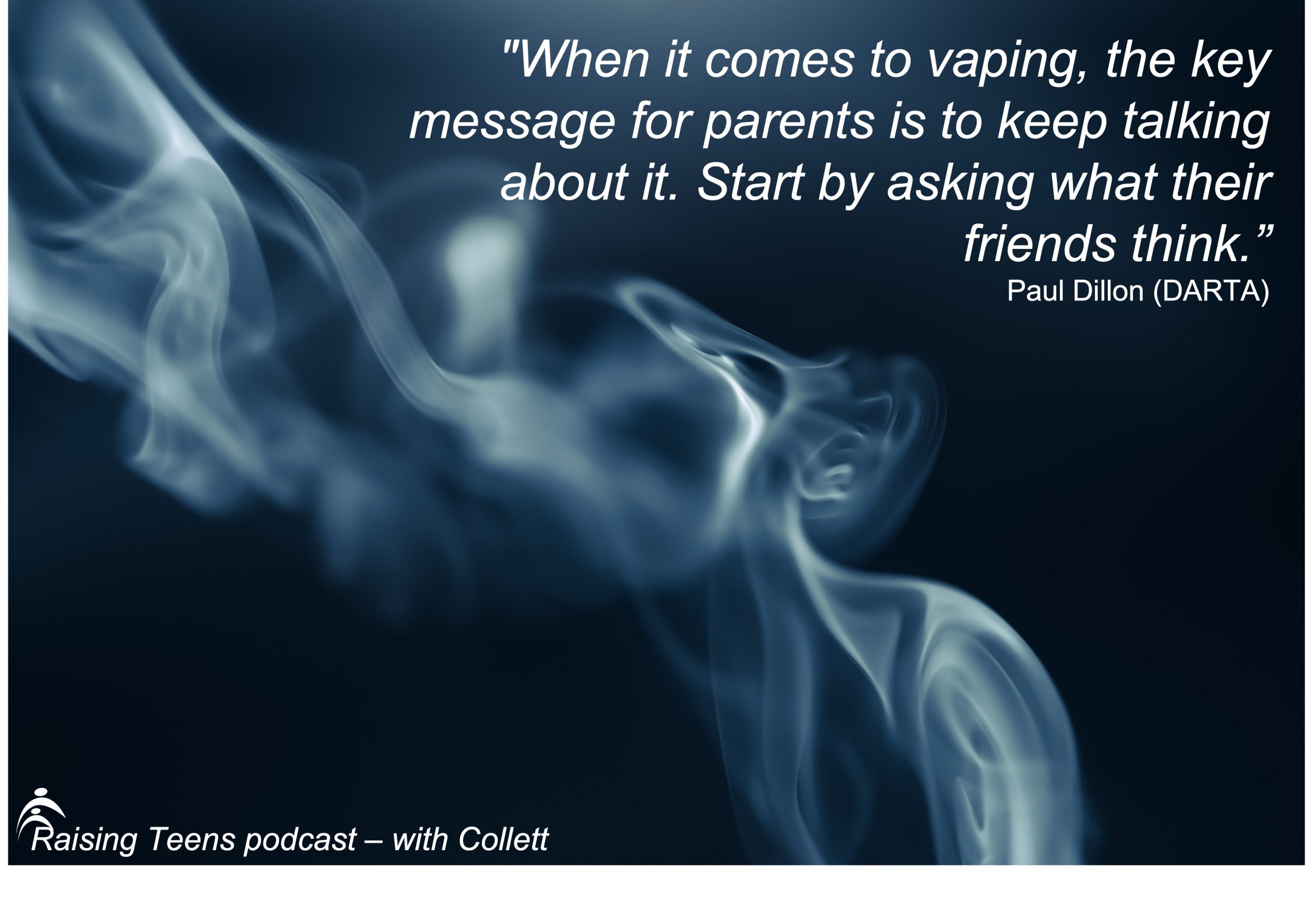
My favourite saying, is the one in the image above, because this is exactly what I encourage parents to do on most topics they want to chat with a teen about.

‘Ask what their friends are doing.’

Not in a way that your teen feels like you are prying, but in a curious way. Teens need to believe that we will not judge them or their friends if they tell us something.  They also respond better when they feel that the topic is part of a conversation, rather than an interrogation. Try to do everything in your power to check your tone and body language when you speak with your teen about a tricky topic.

Sure, you will have strong opinions about drugs alcohol and vaping, – your teen already knows that. What you are aming for at this point is for your teen to feel comfortable enough to talk with you.

Some questions to try:

“So can you tell me about vaping in your school? I know it’s something I never had to face when I was young. You don’t have to give me any names. I’m just curious about what’s happening in your year group.“

Or

“Honey, I found a vape in your bag. Can you tell me about vaping in your school? I know it’s something I never had to face when I was young.”

Let them speak and don’t interrupt (model good communication skills.) Use nods and a few soft interjections like, “Hmhm”, “I see”, “Oh ok”. You want to know it all, what’s their side of the story?  Have they tried it? Why they vaped or continue to vape?

Paul emphasises that when your teen says, “But you don’t understand”, in this case that’s absolutely true. You don’t. We never had vapes around to this extent, even a few years ago, let alone in high school.

2. Express your views about teen vaping and why you feel that way –

You only do this bit only once they have completely finished talking. It is important that they allow you to speak without interruption also. This is another opportunity for learning communication skills, but be sure that what you say isn’t a looooong lecture. It needs to be well thought-out, researched and planned. Stick to your plan. Don’t respond to comments they have made. Paul emphasises that this is not the time. And then this one….

3. Do not use ‘scare tactics’ –

In Paul’s words, ‘Most importantly, don’t throw horror stories at them that you’ve seen reported in the media. Most of these are based on some degree of truth but they’re not the norm and young people know that – stick to a couple of concerns based on the facts.’

4. Avoid judgment –

If your teen has opened up about their friends vaping, this is because they believe they can trust you with the information. Don’t blow it here. If their friend vaping is one of the reasons they’re doing it, Paul emphasises that we need to be careful not to criticise them here.

5. Clearly state your family expectations on vaping –

You can finish your bit by clearly stating your families view and expectations at this point. We have more influence on our teens than we sometimes think we do. Keep your statement matter of fact.

A helpful script from Paul, “As much as I would love to be able to stop you vaping, I can’t control what you do when I’m not with you. I can control what is done in our home. No vaping devices are permitted in this house.”

6. Give your teen time to respond –

… to any thing you have said, or any of the boundaries you have set around vaping.

7. This is an important bit… offer to learn together and look at each other’s sources.

There are a lot of poor sources floating around the internet. The pro and anti vaping lobby groups are both loud. Ask your teen to show you their refences so you can sit together and look through what they found. Show them your sources and look at who provided funding or how reputable a source is. Also, talk about what makes source reputable.

Paul has another great tip sheet (here) for how to respond to your teen factually, when they use common vaping statements, like “But it’s just flavoured vapour.” etc.


Final Thoughts

Keep connecting with your teen. They need you more than you know and often more than they show. Boundaries are important to a young person feeling safe and loved, but boundaries can only come if the relationship is overflowing with love.


Helpful links

Paul is at the forefront of research into these topics and his website ‘DARTA’ is a treasure trove. He has information for schools, even providing downloadable worksheets and power point slides for teachers to use to begin conversations with teens. He has even more information sheets specifically for parents.

Paul’s fact sheet for parents can be found here

Paul’s fact sheet for teachers can be found here.

Don’t miss future episodes or articles

  • Join my Facebook and Instagram community, so you don’t miss out on updates.
  • You can find this episode of the Raising Teens podcast on Spotify, Apple podcasts or anywhere you listen to your favourite podcasts.
  • My books are here.


Below is a direct link to the ‘Vaping, Alcohol & other Drugs’ episode of the Raising Teens podcast, on Spotify👇.  I’d love it if you had a listen and shared Paul Dillon’s insights with someone else who loves their teen.

Paul Dillon has been working in the area of drug education for almost 30 years. Through his own business, Drug and Alcohol Research and Training Australia (DARTA) he has been contracted by many organisations to provide updates on current drug trends, as well as advice on alcohol and other drug issues. He continues to work with many school communities across the country to ensure they have access to good quality information and best practice drug education. In 2009 his best-selling book for parents was published titled ‘Teenagers, Alcohol and Drugs‘ and has since been released internationally. With a broad knowledge of a range of content areas, Paul is regarded as a key social commentator and has featured on television programs such as Sunrise, TODAY and The Project. Paul writes a blog for parents and caregivers, as well as another for young people, and these have recently been released in a podcast format.

Find out more at https://darta.net.au

Generation Z

By Collett Smart
What is the secret to raising healthy teenagers?

They’re not the Snowflake generation


What’s New on the ‘Raising Teens’ Podcast? 


I’ll start with what’s happening for our teens right now

Adolescence can be a fun and exciting time, but it can also be really hard. No one knows that more than the Generation Z themselves. We also know that the last few years have added increasingly to the normal stressors of the teen years. Like me, most experts on adolescent wellbeing were really concerned about our teens during lockdowns and the resulting social distancing that was required. This concern was warranted, as a national survey of 20,000 young people found the pandemic lead to high psychological distress in 75+ per cent of students.

My own children and their friends were also affected by this (as a mum I had a 12-year-old trying to finish primary, a 17yo daughter doing her final year of high school in lockdown and a young adult son doing uni anatomy pracs on zoom!) We saw rites of passage opportunities ripped away, a halt in opportunities for social skills development, a decrease in community based physical activities, leading to increased loneliness and isolation. It’s therefore no surprise that teen mental ill-health is on most parents’ minds right now.


I wanted to offer some hope and support

I had already started the Raising Teens podcast during the pandemic. It started with 10 minute power topics (there are 3 seasons of 10 episodes each). These hold quick tips and ideas to assist parents on: teen anxiety, school refusal, after school meltdowns, questions about alcohol, mental health days, boys and body image, friendship collapse, the power of touch, teens and sleep, and so many more.

However, I began to think about ways that I could bring hope and support to even more parents of teens. I also know that one person cannot possibly be all things for all parents or all teens. i.e One person cannot be an expert on everything (and beware of anyone who implies they are). That’s when the idea for a new format of Raising Teens was born. I know some incredible experts around the country (and overseas), on specific topics on adolescent health and development, and I decided that I wanted parents to be able to more easily find them and access their many incredible resources.


The New Format

So… *drum roll*… from Season 4 onwards, there will be an interview with a guest expert, each Wednesday, on all things teen mental health, teen behaviour or teen wellbeing. My guests are experts and advocates of young people and care deeply about this generation. Like me, they also want to support parents, carers and educators as they do what they do best…that is, supporting and loving their teens.

Season 4 kicks off today. Interviews are now complete, and my amazing producer and team are in the stages of editing the last few episodes. I am so excited for you to hear the practical and helpful advice that each expert brings. Topics coming up this season: vaping, self-harm, eating disorders and body-image, suicide, autistic teens, consent… and heaps more. I don’t shy away from the difficult subjects, but my aim is to bring you support, as well as hope. The episodes are varied and many already come from listener questions I was sent in Seasons 1 to 3, so please feel free to send me a question or topic suggestion you would like covered on the podcast.


We Kick Off with an Expert on Gen Z

Click on the image to download the full pdf 👇 to see some fun info. I am of the walkman, permed hair lot (can you guess?). There’s also the most popular terms used in your generation – hilarious.

What is the secret to raising healthy teenagers?

My first guest for S4. Ep.1

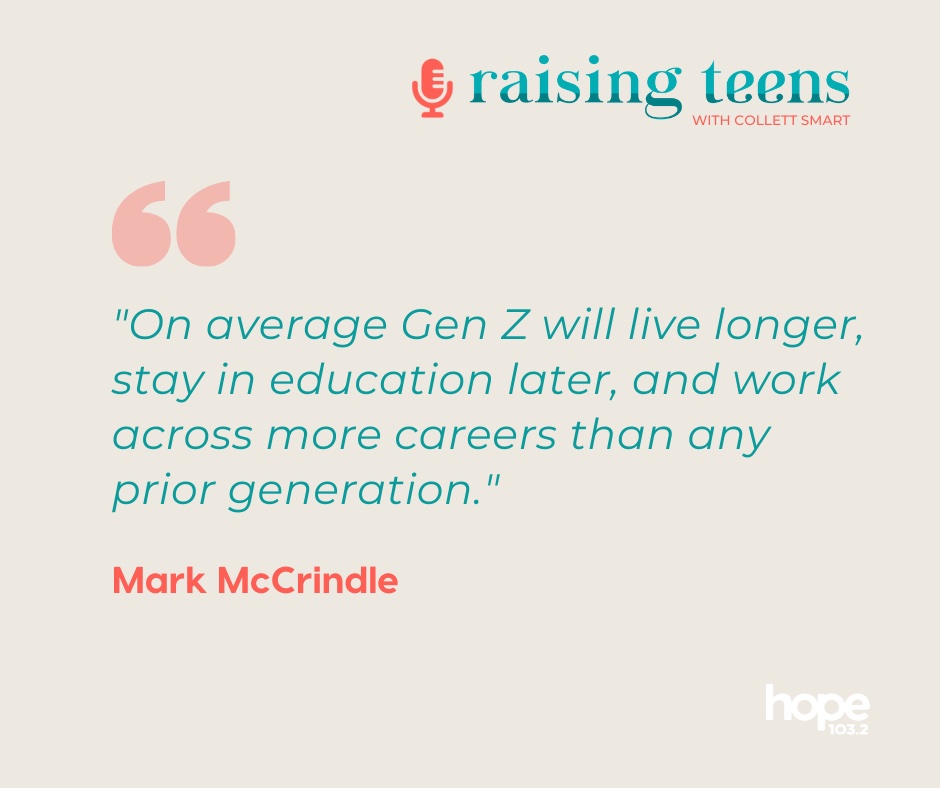
I’m so thrilled to have Mark McCrindle start off episode 1 of the new season format. There is no better person than Mark, to frame what we know about Generation Z (born between 1995 and 2009). Mark is a best-selling author, award winning social researcher and 2x TedX speaker on the generations. This is a lighter topic but a great one, because Mark talks about the trends for this generation of teens from: technology habits, what happened for them during Covid-19 lockdowns, their strengths, to their hopes, their dreams and the future world of work. Mark is so hopeful and positive about the interaction between generations. We also talk briefly about Gen Alpha (which Mark McCrindle named), born between 2010 and 2024, because some are just at the start of the tween years.

Spoiler: He is very frustrated that Gen Z were called the Snowflake Generation.


Finding Mark:

You can find Mark’s work and his books, ‘The ABC of XYZ’ and ‘Generation Alpha’ at McCrindle Research.


Final Thoughts

That was an incredible way to start the series. I love how Mark looks at Gen Z from such a hopeful perspective. They’re not just the selfish snowflake generation. Rather, they’re more likely to seek purpose and look outside of themselves. They care about the people around them and want to make a difference in the environment. That’s the young people I know!


Don’t miss future episodes or articles

  • You can find this episode of the Raising Teens podcast on Spotify, Apple podcasts or anywhere you listen to your favourite podcasts.
  • And join my Facebook and Instagram community, so you don’t miss out on updates. My books are here.


Below is a direct link to the Gen Z episode of the Raising Teens podcast, on Spotify👇.  I’d love it if you had a listen and shared Mark’s insights with someone else who loves their teen.

Mark McCrindle. Mark is a social researcher, best-selling author, influential thought leader, TEDx speaker and Principal of McCrindle Research. He is recognised as a leader in tracking emerging issues and researching social trends.

As an award-winning social researcher and futurist, Mark has appeared across many television networks and other media. His research-based advisory firm, McCrindle, helps organisations all over the world see a clearer picture by understanding the trends that inform strategic thinking.

Find out more at https://mccrindle.com.au

The Importance of Touch


By Collett Smart
What is the secret to raising healthy teenagers?

For many of us, the importance of touch is well known intrinsically.  We often recognise it most when it is missing. Like during a pandemic?


First, the Research 

A shortage of healthy touch can have detrimental effects on our health and wellbeing, even leading to psychologically damaging effects.

Of course, we’ve known for many years about the importance of touch for the healthy physical and psychological growth of infants. Hospitals recommend kangaroo care and skin-to-skin contact for premature babies, as this is proven to aid physical development.

Healthy or pleasant touch, like hugs, sees your brain release a hormone called oxytocin. Often called the ‘hormone of attachment’. It even has a cute nickname – the ‘cuddle hormone’  This hormone seems to improve social bonding and even improves trust, while lowering anxiety and fear.

For instance, hugs and touch are even known to reduce stress. Which means there is real power in ‘good’ touch, safe touch and affectionate touch.

Dr Spence, of Oxford University has fascinating research on the importance of touch. He suggests that smell and touch are linked more closely to the emotional centres of the brain than vision or hearing. Yet, we are visually and aurally bombarded more than ever. 

What Teens Need

The love and affection of parents and siblings is the first place that young people learn about ‘good’ touch! But Spence believes that young people are experiencing ‘touch hunger’. And even though teens may hear that they are loved, they need to physically ‘feel’ love to truly fulfil the affection they crave.

Love needs touch to make it real.

Particularly fascinating, as the teen years are the time when our children seem to be pushing us away…

It is our job as parents and primary carers to fill our teen’s touch hunger, in ways that are meaningful and loving to them. This leads naturally into some of the most important conversations we have with our children – body boundaries and body safety, good touch and bad touch. (Not every week, or even every month, but periodically throughout their growth.)


But What If My Teen Hates Hugs or Pushes Me Away?

If you are unsure, ask your teen what types of touch feel safe and loving for them.

Also keep in mind that teens on the autism spectrum, don’t like some forms of touch. So we must stop if they show they don’t want to be hugged or touched in certain ways too.

But it is imperative that we don’t back off from affectionate touch altogether, just because our teen doesn’t like hugs. Look for ways to communicate your love for your teen, through the types of touch that speak their language.


What if YOU Hate Hugs?

Your own feelings and dislike for certain types of touch can lead to powerful conversations with teens, about other people’s body boundaries.

But again, look for ways to communicate your love for your teen through the types of touch that communicates love for both of you. This can also spark discussions about mutual affection within healthy relationships.


Some ideas for affectionate touch:

  • a tight side hug
  • a full-on bear-hug
  • a gentle hand squeeze
  • head massages at night
  • bedtime arm tickles
  • shoulder massages
  • fist bumps
  • a reassuring squeeze of the upper arm
  • hair ruffles
  • rough-and-tumble play
  • sitting close together on the couch while reading a book or watching a movie
  • (add your teen’s choice here)


Final Thoughts

Don’t give up on your teen when they push you away. Sometimes they’re testing the boundaries of your relationship, sometimes they’ve just had a bad day, sometimes they don’t even know why they’re doing it.

One thing they need most of all, is to know that you’re never giving up on reaching out to them.


Here is my podcast on this topic?.  Perhaps there’s a parent of a teen who really needs to hear this? Please share with them today.


I wrote more about the power of good touch in my book ‘They’ll be Okay’ in Conversation#1.

Collett Smart is a psychologist, qualified teacher, speaker and internationally published author of, ‘They’ll be Okay: 15 Conversations to help your child through troubled times’. The heart of Collett’s work is to support and bring Hope to parents of tweens and teens. She lives with her husband and 3 children in Sydney, Australia. Find out more at www.raisingteenagers.com.au

How Do You Talk To Your Teen About Porn?

by Collett Smart

how do you talk to your teen about porn

(Update: I have added the * so that this article gets through your filters)


Young people are naturally curious and innately want to know more about love and sex, yet porn has the ability to destroy everything that is good about romance, love and relationships. There is nothing empathic or kind about p*rn.


Neither sex nor sexual attraction is inherently bad – it is part of normal, healthy development – in the right context. We ought to be encouraging young people to be safe, healthy and confident about their bodies and sexual development. The problem is that the sexualised wallpaper of society does not allow for this natural development to occur. It forces our teens into unhealthy beliefs and practices, before many have even had their first kiss.

We know that children (both boys and girls) as young as nine have been exposed to p*rnography, even when they did not intend to access it. So as a start, it is safe to assume that teens already know what it is. The flood of p*rn, so easily available online, has become our kids’ primary source of sexual education, forcing them into an early awareness of unhealthy, risky, violent and dangerous sexual practices.

If not specifically addressed, it is likely to erode their emotional, mental, physical and relational development.

This is a public health crisis. Like smoking or other public health issues, this will have long-term consequences – Dr Joe Tucci, CEO, Australian Childhood Foundation

In fact, p*rnography worries young people themselves, so the adults in their lives must absolutely engage in this conversation with them. Remember: just because your child does not mention it, does not mean they have not been exposed.

Often, kids ‘don’t tell’ because they are worried about their parents finding out what they have been doing online, are afraid they will have their devices confiscated, or felt they were to blame if someone showed them something.

Ok, so how do you talk to your tween about porn?


In Conversation

We will need to have lots of small talks, at every age, stage or level of exposure. This is why it is so important for young people to have someone to talk with when they first encounter porn.


Here are some points to keep in mind:

  • Avoid shame – When we discover a child has seen p*rnography, we must not shame them! Shame often leads porn viewing to become a secretive and potentially a more compulsive behaviour.
  • Explain to them, “Your body’s response is normal. To be curious or even aroused when first encountering p*rnography is our body’s natural inbuilt physiological response, but it’s what we choose to do after our first encounters with p*rnography that put us onto a healthy or destructive path. Do you continue to look for more and more opportunities to watch porn, do you tell a trusted adult about it or do you find alternative healthy activities to engage in?”
  • Talk about p*rn as a poisonous script for sexual behaviour versus lessons in intimacy. “P*rnland” sex contains distorted messages and is filled with myths and stereotypes, and is often violent and abusive. It is the opposite of healthy intimacy.
  • P*rnography normalises treating people as objects.
  • Make them aware that consistent viewing of p*rnography leads to negative biological, psychological and social effects. There is growing evidence of the negative effects on the brain and young men struggling with Erectile Dysfunction.


When you discover that your t(w)een has seen p*rn:

If we talk with our children about the harms of p*rnography, does that mean they will never see it or even seek it out? Unfortunately, no! We’ve already ascertained that they will see p*rn, sooner than we feel prepared for – young people are curious and p*rn is everywhere. But we are in this for the long haul. We are obligated to inform our tweens of the grave risks they face if they choose porn. We have to teach them not just the biological truths, but also about their own emotional vulnerabilities and to value the highest standard of care for others. (More on this in upcoming articles.)


The BREATHE method (in brief), which I developed for my book.


Be ready and breathe. Be armed with knowledge about this topic. Take some time to work this out if you need to, but don’t avoid talking about it.

Reassure your child that you are not angry. Explain calmly what you found and tell them that you are there for them and you will now work through this together.

Expect initial denials or promises, because kids are embarrassed or afraid of your reaction.

Activities. Ensure your child’s life is filled with lots of healthy online and offline activities.

Technology check. Have you set up blocking software and parental controls on children and teens’ devices. Is technology out of bedrooms? What is the screen time balance in your home? (Note: Social media is not recommended for children under the age of 13.)

Have a plan. Sit with your child and draw up a plan for what they can do when future exposure occurs—because it will!

Enlist support. If viewing has become compulsive, seek the help of a child psychologist.


One last thought

No matter how prepared you think you are to talk about this topic, when it infiltrates your own family you never feel ready. It is natural for parents to want to protect their children from harm, and most parents I speak to believe porn is harmful. It’s okay to feel confronted by the fact that this ‘statistic’ is now a reality in your house.

It’s okay to take a little time before responding. Don’t jump straight in and blurt out your fears and concerns. Go for a walk, if necessary, to calm yourself down and think about what you might say next. If you messed up, clammed up, stammered or even yelled – apologise and try again! Your teen won’t remember the one or two times you fumbled your parenting ball. They will remember the over-arching atmosphere of your relationship – that you were open enough to say sorry, that you cared and that you were prepared to talk to them about anything! 

So, be ready to listen, then talk, then listen, and then talk again…


Please support or encourage a parent, by sharing this article with them.


Collett Smart is a psychologist, qualified teacher, speaker and internationally published author. The heart of Collett’s work is to support and bring Hope to parents of tweens and teens. She lives with her husband and 3 children in Sydney, Australia. Find out more at www.raisingteenagers.com.au


Adapted from Conversation #13 – Pornography: ‘We need to talk about porn.’ in my book, They’ll Be Okay: 15 Conversations to Help Your Child Through Troubled Times (Hachette, 2019). All research papers are available in the book.

A fantastic online resource, for parents, has been developed by Culture Reframed.


My thoughts on talking to children and teens about pornography, on The Morning Show below:


A version of this article was printed in the Mums At the Table magazine.

Connecting with Teens – 6 Tips

connecting with teens

“I love teenagers!”


Yet… I find that whenever I say this phrase people look at me and chuckle, as if waiting for the punchline.

There is none.

It’s true! I really do love teenagers! Every year I get to spend a week in January with a few hundred teenagers in Australia. It is truely one of my favourite weeks of the year. In other months of the year I get to spend time connecting with teens in schools in other countries. My favourite weekends are those when my own teens/young adults bring over a bunch of their friends, and they’re all laughing, loud and crazy. (And I get to feed them lots of food.) In my day job, I seem to keep gravitating toward settings where I can work with and support teenagers.


The Stereotype

I find myself frustrated though, because somehow it’s still socially acceptable to belittle teens. Verbal teen sledging is like a national sport.  Headlines and conversations always go something like… ‘This generation is baffling’ or, ‘Teens are out of control/lazy/selfish’ and, the latest favourites, ‘Teen selfies are creating a generation of narcissists’ or, ‘All teens are addicted to games/phones/social media/ (add your own here)’.

Perhaps I will deal with some of the ‘myths vs facts’ in the above topics more specifically, in the coming months –  but it’s the ‘angry, defiant, moody, uncommunicative teen’ stereotypes that have me worried.

I think that we need to stop with the generalisations. They don’t help anyone – and simply act to further the divide between teens and adults. It’s no wonder parents of young children look at me wide eyed and say things like, “I’m just dreading the teen years.”


The Reality

I’m not pretending that the teens I have worked with over the last 20+ years have never struggled with life issues. Or that my own teens are perfect little darlings, who never answer back, always pull their weight and are forever cheerful – but then again – us adults aren’t much different either. I often feel as though we expect more from our teens than we expect from ourselves.

During their teens our kids go through changes – massive changes in fact! Their brains are changing, but not all in the same way or at the same time (see more brain stuff here and here).  Add to this their changing bodies and the development of a strong desire to become independent of us. (As there should be. Who wants a 30-year-old man-child still sitting in their lounge room playing Fortnite all day?)

So of course there will be challenging times, with some struggling more than others. Particular periods are hard – really hard. Anywhere there are a bunch of humans living in a confined space is never going to be easy. There will be days (maybe weeks? Or months?) when you second guess yourself, and wonder, “Am I doing this right?”, “Am I just messing them up?”, “Will they be ok?” – more on these issues in later posts too.


But may I encourage you? I believe in the potential of this generation. For the most part – they will be okay!


How might we change the teen stereotype?


It starts with us – the adults.


Resilient Youth Australia survey of 78,000 children and teens, found a significant drop in resilience between 10 years of age and 15 years old. The revelation for me, was that 15-year-olds, are far less likely to feel they have an adult who listens to them or to feel ‘very hopeful’. Over 40 percent of the students felt that they did not have anyone who knew them very well – that is, who understood how they thought or felt. Almost a quarter said, ‘they had no one to talk to if they were upset, no one they could trust and no one to depend on.’

As to why there is such a drop in confidence towards the mid-teen years, is that parents often feel less close to their children during adolescence.

Our young people need us – desperately!


The good news is that young people really do want to hear from adults.
 

Despite what we hear about the current generation gap and terms like ‘screenagers’, and ‘Generation Me’, Mission Australia’s annual surveys of thousands of young people, consistently indicate, ‘friendships and family relationships rank as their two most highly valued items’. While, ‘friend/s and parent/s’ were the two most commonly cited sources of help for young people – higher than the internet!

There it is – you matter in your teen’s life, and you must step up!


So how might we enjoy their teen years more?


Begin with self-awareness

As parents it helps to become aware of our own baggage – every one of us has some. (Those things that affected us in our teens, and the insecurities or issues that we are still working on.) Sometimes we unhelpfully project them onto our children, when their struggles are completely different to ours. Also, be ok with the fact that you may be uncertain about your parenting decisions at times. You are allowed to make mistakes and ask for advice.


Follow self-awareness with an awareness of teens’ needs and development

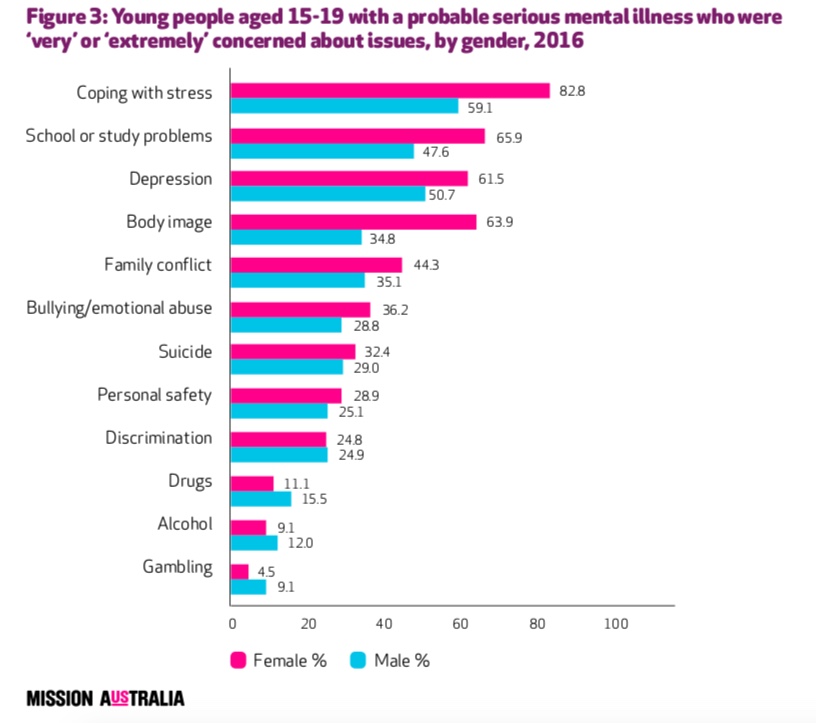
Know what teens need. The afore mentioned Mission Australia, jointly with the Black Dog Institute, regularly list the top issues teens face. This helps us to begin conversations with the young people in our lives, about how they might support their friends and whether they need help themselves. When young people get to know how their generation is feeling, this normalises their struggle and helps them not to feel alone.


More Specifically

1.  Just stand beside the emotional roller coaster – you don’t need to join the ride.


It is completely normal for teens’ emotions to be quite fluid. Adolescence is a time when many experience their highest highs and lowest lows. It is dizzying and exciting when given more independence, but also quite frightening at times.

The generalisation is to blame teen emotion on ‘raging hormones’, when it is so much more complex than that. Teens are trying to work out who they are, which is why self-scrutiny can be heightened. Some of the moodiness comes from their insecurities and wondering about their future. Teens can feel deeply and are still learning how to express themselves appropriately – especially if they feel disempowered, guilty or overwhelmed about their world.

AVOID – dismissing their feelings as silly or inconsequential.

DO – acknowledge their emotions.
In the same way you need support when things get overwhelming – be available and be kind. Let them know you are waiting in the wings if they would like support, to talk, or just a cup of tea.

DO – step away.
Wait for the big emotions to pass, before trying to engage in controversial or heated topics.


2.  On communication – be quiet and listen more than you talk!


AVOID – the lectures.
Don’t grill them with questions, or offer instant solutions whenever they tell you something.

DO – listen more than talk.
Our teens need to feel heard. They need to really know that their opinions matter to us. If they know that we respect their opinions and won’t laugh at their questions, we will find that they open up and begin to communicate, a little more each time.

When they do open up (and it’s usually at 11:59pm), drop everything! Use those times to soak in the opportunities to let them connect with you. Just sit back and listen.
Don’t be afraid of the pauses. The pauses allow your teen to sift through and gather his thoughts. It implies comfort in your presence.

DO – apologise when you mess up. Modelling how to ask for forgiveness is one of the best life lessons you can give your teen.

DO – use humour
This is the best bit. Teens are hilarious and quick witted. Send your teen funny memes, or tell them embarrassing stories about your youth. Teens can sniff out ‘the lecture’, but if you tell them anecdotes of your own funny, awkward or painful stories from your teen years, they usually respond well to that. You need to be a bit vulnerable to give teens permission to be vulnerable with you.

DO – Talk about some of your current daily struggles (without adding too much detail to burden them), because adults are human too. Shielding your teen from every challenge you face sets her up to feel inadequate in her own adult years.


3.  Boundaries – know they will shift and change.


AVOID – being just another BFF (Best Friend Forever) teens have lots of those.
They need you to be the adult.

AVOID – being too rigid.
Boundaries should be for safety, not suffocation. Naturally teens won’t like all your boundaries and a few things will be non-negotiable, but be open to letting some things change with age and stage.
The research indicates that the parent who simply demands obedience to his authority, and is big or strong enough to get it, will get short-term compliance, but long-term rebellion.

AVOID – expecting instant compliance.
Too often, parents can expect teens to jump up and comply with their requests immediately – something we don’t do ourselves, or even expect from a spouse (I know – I am at fault here). Perhaps say you will give them a few (mutually agreed upon) minutes, to wrap up what they are doing.

DO – set reasonable boundaries.
I mentioned the teenage brain – so teens need guidance and age appropriate boundaries, because they’re not fully grown adults yet. But because teens are so different, some (even in the same home) will need different types of boundaries to others.

DO – pick your battles carefully.
Because your relationship is more important than always being right. You might think to yourself, “What is my reason for this rule?”, “Is it worth it?”
Areas where you will need to consider boundaries might include; expectations to be at some family meals, what screen time balance looks like, alcohol and partiesdating, how they treat others

DO – allow for independence.
They still need us, but they’re also looking for increasing independence. Teens can only learn when given opportunities to try (and sometimes fail at) new things. When teens are given the freedom to choose in many areas of their lives, they are more likely to listen to parents’ opinions on the bigger issues. So perhaps let the haircut, clothing choice, or even that Maths test go, for the sake of the values based stuff?

DO – expect them to be part of the process.
Parents can explain to teens that to earn the privilege of independence, they need to be willing to engage in discussions about new age related behaviours and boundaries.

DO – expect them to show up.
By ‘show up’ I mean pull their weight and help out in the home. You are not a hotel.

DO – allow for natural consequences, if they don’t follow through with expectations.
e.g. “I’m afraid you will have to be at the party late, as I need to wait until you have unpacked the dishwasher before we can leave.”
If they demonstrate that they are irresponsible or unsafe with the trust you have shown, you may need to pull the boundary tighter again, for a time.


4.  Celebrate the process


Teens are people. Yes, their brains are still developing, but they’re not dumb. They sometimes make poor decisions because they don’t have the past experiences to draw from that we do. Their stories are still developing – and that’s exciting and worth celebrating.

AVOID constant criticism.
It’s our job to teach our children certain skills, and gentle correction is part of parenting. But this shouldn’t be your default conversation. A teen should feel as though their home is a safe haven. A place they are accepted.
If they constantly feel as though they can’t do much right, they will either withdraw emotionally (by communicating less) or physically (by finding other places to hang out.)

DO – catch them doing lots of things well, and then tell them what you noticed. Say thank you.

DO – be respectful.
Don’t complain about them publicly, or in online open forums, where it is permanently out for the world to see. Can you imagine standing in the next aisle at a shopping centre and hearing your partner complain about you to a neighbour?
Find a friend or family member that you can privately talk with (rant to even) and ask advice of, when things get tough.


5.  When confrontation happens


Because it will 😉

AVOID – taking things personally.
Remember, you are the adult. You don’t need your teen to like you all of the time. Make sure that you have your own support people to lean on.

DO – know when to back off and cut them some slack, or talk when things have settled down.
If you find there is lot of confrontation, tell your teen that you would like to really know more about them, understand them better and you would like to try and learn more about their world. Be honest and tell your teen that you really would like to improve your relationship with them.
These types of discussions often work better on neutral territory, such as a coffee shop, a park, or in the car without eye contact.

DO – seek professional help if you and your teen are stuck.


6.  Mostly – find your teen’s love language


AVOID – giving your teen endless ‘space’.
Naturally, teens seek independence and sometimes solitude, but they still innately desire physical connection with their families.

DO – display truckloads of love.
Hug your teenager often, or physically connect with them in a way they feel comfortable. Teens need us to be both physically and emotionally present for them. If you are unsure, ask them what types of physical affection they prefer now that they are getting older (side hugs, firm or soft hand squeezes, sitting closely together on the couch watching a movie, head massages…) Tell your teen regularly, that you find them interesting, that you love their conversations and hearing their ideas.


One last thing

I truly believe in the potential of this generation. I love how teens think. I love their passion and zest for life. Teens are capable, generous, kind, funny and deeply inquisitive. Let’s change the narrative.



More from ‘They’ll be Okay‘ (Hachette)


Collett Smart is a psychologist, qualified teacher, speaker and internationally published author. The heart of Collett’s work is to support and bring Hope to parents of tweens and teens. She lives with her husband and 3 children in Sydney, Australia. Find out more at www.raisingteenagers.com.au
Pin It on Pinterest