Many teens are able to tackle some of the online education tasks set for them independently. But what happens if you have a teen with an ADHD diagnosis?
We’re all in the thick of ‘physical distancing’ right now. Parents are juggling what feels like 5 jobs. Their own, and then the education of their children (aren’t teachers incredible?). Parents are encouraged to be kind to themselves, and their children in this time, because everybody is feeling a little anxious. Many experts have used the phrase, “Lower the bar.” Lower the expectations of ourselves and our children.
Do some school work, but ensure that this is balanced with lots of other connection, fun and chill-out time. This is not a normal ‘homeschooling’ set up. It has been coined, ‘crisis schooling’.
Working at home is even more difficult for students with ADHD and many parents have asked for ideas on how to support their tweens and teens. So I approached Tim Connell, a special education consultant, for his best tips. Here is his expert advice:
Why is Working at Home so Difficult for Students with ADHD?
Students with ADHD benefit from the routine and structure of school. Specifically, these routines help to ‘outsource’ some of the executive functions and free up cognitive resource that can now be allocated to Selective and Sustained Attention.
How Can Parents Help?
1. Adults at home can help by replicating as much of the school routine as possible including;
Getting up at the same time as would be the case for school – avoid getting up at the ‘last minute’ before Period 1 begins.
Allowing plenty of time to eat, shower and organise their workspace.
Ensuring they eat a good breakfast – the brain needs glycogen to fuel attention.
Ensuring they are ready to enter the ‘virtual classroom’ for Period 1.
Regularly checking in, either in person or text if you’re not at home.
Ensuring their sleep pattern remains regular. (i.e.getting enough sleep and not going to bed too late.)
Continuing to follow the treatment plan provided by your clinician/psychologist.
2. What about the work environment?
The bedroom is probably not the best place to work, as it will usually be full of potential distractions for a teen with ADHD.
If working in the bedroom is unavoidable then students should be sitting at a desk rather than working on laptop on the bed.
A work environment should be quiet, uncluttered and all equipment should be within easy reach – a timer is a useful additional piece of equipment. See the Pomodoro Technique, (Collett’s note – this involves working in 25 minute blocks of time.I have recommended this technique to both adults and teens with ADHD, and many have found this very effective.)
3. My child seems to need more breaks at home – is that ok?
Working at home in most cases will be more cognitively effortful. Particularly as students and teachers adapt to this process and lessons become a more consistent balance of video and online platforms.
Regular breaks are an important opportunity to ‘recharge’ cognitively. The danger for students with ADHD is that returning to work after a break is also cognitively effortful and requires some structured support.
Program short breaks into the day, in advance – ideally after periods of sustained attention (as above).
Do NOT use breaks to engage in a favoured activity such as gaming, because this makes it much harder to return to work.
Eat and drink during the break to restore glycogen levels
Add physical activity into some breaks
Time all breaks and physically rehearse the process of getting back to the desk and starting work. This helps to build muscle memory and automaticity.
4. Accountability – I feel like I’m nagging all day during this difficult time.
Students with ADHD benefit from being held accountable for their work (Dr Russel Barkley explains this). Adults at home can help by;
Clarifying exactly what work is due each day/week (Collett’s note – Asking teachers to keep you in the loop can be helpful here).
Helping to break longer tasks down into smaller, time bound sub-tasks (again, see the Pomodoro Technique mentioned above).
Using the same high level of specific performance-based praise that occurs at school.
Agreeing in advance on expected work behaviours and attitudes.
Agreeing in advance on rewards and sanctions.
Rewarding work completion and independent organisation as appropriate.
Implementing consequences for non-completion of work.
5. My child has an IAP/IEP (Individualised Education Plan) at School – what could this look like at home?
In most cases the individual adjustments within each student’s plan will be variations on those described above.
Collett’s Last Thoughts on Supporting your Child at Home
If you or your child are feeling overwhelmed, it is more than okay to have a break and go back to something later. If stress levels are escalating, it is important that you contact your child’s teacher/s. Schools are not expecting parents to have the same level of skill as a trained teacher. Educators are brilliant at adjusting work and schedules according to their students’ needs or abilities, because they want the best for them.
Tim Connell is an Australian special education consultant with over 20 years’ experience across all sectors. Tim has worked with hundreds of students and schools in a variety of executive and special education consultancy roles. He has presented extensively at schools and conferences. You can find out more about Tim at: www.timconnellaustralia.com
If you need further assistance, Tim offers support by;
Discussing ways your child’s IEP/IAP can be implemented at home.
Discussing additional adjustments to communication, environment and curriculum that may be relevant at home.
Discussing specific scenarios that may be causing concern.
Like many reading this, I am a parent (I have 3 children, one already an adult) – and the talk of COVID-19 has been part of our daily conversation in the last weeks. Especially since the flow of information (and misinformation) has picked up. It’s difficult to ignore isn’t it? Reports are everywhere. On every screen, in every feed, every board meeting, work site and school staff meeting. I think many of us have vacillated between the ‘what nows?’ and the ‘what ifs?’
We know that we can’t shield our tweens and teens, because they will hear about it anyway, from peers, siblings, online… But how much is too much information? And what is age appropriate? How do we help our teens and tweens manage their anxiety about COVID-19? How do we steer away from the fear?
As a Start
Model
Even teenagers look to the adults in their lives for behavioural cues. They learn from us about how concerned they should be about anything unknown or new. Even without words, our behaviour can inadvertently create a climate of distress in our homes. So it is important that we have support people to turn to, if we are feeling anxious ourselves.
Normalise Anxiety
Concern for the unknown or some new disease is a perfectly normal reaction. Encourage your children that not all anxiety is bad. It is our brain’s brilliant way of keeping us safe from and alert to danger. Anxiety works like an alarm system, which prompts us to think of ways to look after ourselves.
It’s just that an oversensitive alarm system can lead us to irrational thoughts and fears, which affect our healthy daily functioning. So how do we keep this alarm system in check, during this time? (I’ll get to that soon…)
Monitor your child
Even within developmental stages, children will display differences in how they respond to certain pieces of news or information. Just because your tween does not verbalise that they feel anxious (they may not even recognise anxiety in themselves), does not mean they are not struggling with something they have heard.
You know your child best, so looks for signs that they are not doing well. I.e. regression, sleep issues (struggling to fall asleep, waking up in the night and worrying, nightmares), changes in appetite, changes in behaviour (acting out, withdrawal, bouts of crying for seemingly small things), separation anxiety (not wanting to go to school, usual activities or to be left alone), sudden headaches or tummy aches and drop in school performance.
What to Say
Be proactive
At this time, it is a good idea to be proactive. Start by finding out what your child has heard and what they know, before launching into too many details.
This can be done by asking open ended questions like, “Can you tell me what you heard about that?”
You can also ask specifically if they have any fears or concerns. Keep in mind that your t(w)een’s primary response to ‘scary’ or unknown news can often be emotional, rather than intellectual.
The real question behind their question is usually, “Am I safe?”
This is the most important bit – Listen well!
When your kids come home with stories from a classmate who said that you or grandma might die, this could be the underlying fear of the COVID-19 stories, for them.
Rather than simply saying, “Oh, I’ll be fine.” or “That’s a silly thing to say.” or, “Just forget about it.” – acknowledge the emotion with something like, “That must have felt scary to hear.” or “That must have worried you.” Do lots of listening. Ask more open ended questions and then listen some more. Even if your teens’s question or fear seems ‘silly’ to you – don’t minimise.
If it is important to them it should be important to you. This helps your child feel heard and develops a sense that you care about them.
How Much to Say
Tailor your approach to each child’s age, maturity level, ability to process information and exposure to reports about the virus. Molly Gardner, a paediatric psychologist told TIME magazine, “Being informed and being anxious are two different things… The more we beat around the bush with kids, the more they might get confused.”
Preteens and teens
With most very young children, we know that shielding is the best option, but older children and teens have more exposure to current events. I have written before, that adults can sometimes assume their teens are coping with the overload of media reported trauma – while quietly – they are imploding. For many teens, their imaginations (fuelled by sometimes unreliable social media reported trauma and a constant stream of graphic images) can magnify the events to even greater levels of terror.
Our tweens and teens can usually cope with frank discussions. Again, stick to the facts. However, highlighting the misinformation and hype, represented in some media reports, can teach young people to become more critical media users themselves. Find realistic and trusted news sources that your family can follow. Brainstorm with teens, some practical steps to follow.
What to Do
Astudyabout empowering families during a healthcare crisis recommends the CARE approach:
Choices Agenda Resilience Emotional Support
Engaging the CARE principles (not necessarily in this order) helps young people and families feel empowered. It reduces, and may even improve the risk of anxiety and trauma responses.
(1) CHOICES – Offer power in a powerless environment
This might look like:
Channelling their anxiety into useful action. i.e. everyone can do something to help slow the spread of disease, using hand sanitiser, by coughing into your elbow, washing your hands regularly.
Distraction – because when we fixate on negative information our anxiety grows. Yet, if we turn our attention to healthy activities, it shrinks. Ask your child to choose some healthy distraction activities, e.g. Doing their homework, remaining physically active, cuddling a pet, playing a board game or watching a favourite show.
Encouraging teens to take a break from, or at least limit exposure to, news and social media reports on the virus.
(2) AGENDA – Let children and families know what to expect and what is expected of them.
This could be by explaining the school’s plan for learning, if the school were to close for a few weeks. (Final year students might be especially anxious about this).
Think about what activities they could do during this time (both academic and for relaxation).
If your child is disappointed that a scheduled event has been cancelled, just listen. Let them vent.
Explain what ‘physical distancing’ (social distancing) means, and why ‘flattening the curve‘ is an important part of government decisions.
Then talk about what steps you would take if a family member did contract the virus (because kids are wondering about this!) What is your family plan?
(3) RESILIENCE – Highlight strengths and reframe negatives
Research suggests that teenagers feel better when they turn their attention to supporting others during difficulty. There is great power in volunteering.
Talk about what ‘love in action’ looks like in a time like this. Think about what you would do to support grandparents, family members or neighbours who are vulnerable or have a disability. E.g. Collect and drop off food parcels, toiletries and medicines.
Model mindfulness and gratitude (without minimising teens’ concerns)
Find current examples of ‘helpers’. Like the one about 19-year-old NBL star Zion Williamson’s incredible act of kindness.
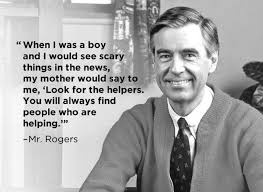
My favourite quote on reframing negatives is by Fred Rogers,
(4) EMOTIONAL SUPPORT – Recognise and normalise common fears and responses
Keep providing daily emotional first aid. Check in on how your children are feeling.
Remind them you are there to listen to any questions or concerns.
Some young people find that their faith brings them great comfort, in times of crisis. Support them in this.
You might like to help your t(w)een begin a daily (short term) journal or worry box, where they can write down their fears. Then be sure to balance these with something from principles 1, 2 and 3.
One last thought – Find Some Humour
Humour can often highlight the craziness of humanity, but also normalise our response to the unknown. There are so many toilet paper memes going around. See who can find the best one.
My colleague, Michelle Mitchell, is a an educator and parenting author. Here she talks with such honesty, about the transition (for parents and young adults) from high school to the world beyond… and when you suddenly have a young adult with bold Ideas
My young adult with bold ideas
12 months ago my son came to my husband and I with an “idea”. Year 12 was finished. The safety of school was over. Schoolies was done. He was faced with the big decision of what to do with 8 hours, five days a week. It was time to adult. But he was a young adult with bold ideas.
“I want to start a film and photography business,” he said, completely out of the blue.
With slightly raised eyebrows my husband and I said, “Why don’t you go to university and study film, work for someone for a few years and then start a business from there?”
It sounded completely logical to me, but we didn’t get much enthusiasm back.
“I don’t want to study. I want to make film,” he insisted.
The discussion continued as we talked about building a strong foundation for life, the importance of life experience, the real pressure of business and the fact that he didn’t have a dollar to his name.
Still no love back. We weren’t winning.
I was looking for flaws in my argument, but I couldn’t find any. The only thing I could find was a child who insistently knew better. He was sure of himself and the future he wanted to create.
For anyone out there thinking, “What is she complaining about?? That is wonderful!!!” I DO AGREE. HOWEVER, I’d like to be very honest in an attempt to help parents who might find themselves in the same headspace. The idea of a 17-year-old running a business sounded a lot more wonderful when it was someone else’s child. When it was my academically capable 17-year-old who I thought should pursue a degree (or some work experience) it got a little more real.
As parents we think a lot. I thought about all my son’s options. I thought about how tough business was. I thought about everything he didn’t know about invoicing and insurance and time-management. I thought about the time he might be wasting while others were ‘getting ahead’. I thought way too much, and then wrapped it up in a bow and gave it to my son to unpack.
So, what happened next?
My dear son respectfully went against almost all of my well-intended advice. He listened, and then chose to reject it WITH my full blessing.
I had to accept that my son was amongst the small percentage of kids who have entrepreneurship in their blood. They like pressure. They thrive when the chase is on. They want to run their own course. They might succeed or fail valiantly, but they will do it on their own terms.
It would have been very easy to force or manipulate him into taking a more traditional route. I was tempted to do both. When I saw my son wobble and stumble I wanted to mention that perhaps a ‘normal’ job would serve him better, but I had to refrain from stepping in. I realised pretty early on that if I didn’t embrace his adventure, or if I tried to put someone else’s journey on his shoulders, he would lose himself.
What Have I Learnt About Championing Uniqueness?
It can be hard, especially when we think we know better. As a parent, I prided myself on knowing my two boys. This type of knowing has served me well in previous years. However, as they have become young adults, the ability to NOT KNOW has been my greatest blessing. Not knowing has allowed me to step back, and observe the adult which is emerging.
Practically How Did I Do This?
These are the five things which have been critical in helping me firstly accept, and then support my son’s dreams:
1. Connecting with the “Why”
I speak to so many young people, my son included, who believe that you don’t need a degree to build a career. The “work from anywhere” mentality has captured their imagination, and the internet has given them the thumbs up to pursue their dreams on their terms. This generation of entrepreneurs are built to create change in their world. They think differently. They move differently. They are very connected to the cultural climate around them. The more we can invest into the “why” that motivates our kids to create, the better equipped they will be to know how their gifts can make a difference in the world. When the going gets tough, “why” is the only thing that will carry them through.
2. Finding the Right Fit
It takes time to discover where ideas connect and resonate and become financially viable, so get ready for a lot of changes. From the outside watching someone start a business it can look like chaos, but there is so much processing happening behind all the commotion. If your son or daughter is creative they will be forever coming up with great ideas, failing, coming up with another idea and the journey continues. That’s a good thing. Being supportive of change, decision making, stepping forward and risk taking will only empower them. Our saying is, “Keep what is working. Throw out the rest. Don’t talk about it. Change it.”
3. A Business Not a Hobby
This is an interesting one! Market reality is a real lesson that all creatives NEED to learn. Financial viability gives an indication of whether their gifts are resonating with people. Cash is king, and there is a difference between a business and a lifestyle business or hobby. In my opinion, realistic goals should be something that young adults should be accountable to, especially if parents are supporting them financially. We have set monthly financial targets with my boy, to help keep him on track. We certainly don’t hold these over his head, but we work towards them together.
4. I Won’t Pick You Up
As parents, our hearts and minds are fully supporting our kids. I am sometimes annoyingly ‘involved’ in my son’s daily accomplishments. However, one of the things my husband and I have clearly said to our son is, “We will not financially pick you up (at all) but we will give you a safe place to fall.” I am not offering any loans or get-out-of-jail-free cards. (Some are surprised at this.) I don’t think he needs a loan to start a business. In fact, I think it would only be a hinderance to him. I will put a roof over his head and feed him at night. Business is tough, and I don’t want to shelter him from that.
5. Walk the Fine Line Carefully
As exceptional as being in business at 17 sounds, it also comes with its challenges of knowing when and how to ask for help. Not a “come and rescue me” type of help, but an “I have a very specific question” type of help. And when it comes to answering those questions, I have found there is a very fine line between taking over and offering a practical support. We ultimately want to help them fine-tune their ears to their inner voice. Try questions like: What options are you considering? Is there information you are missing? Who might have done this before? What is the next best step forward? How is this different or the same as past experiences? Can you reduce the risks? Do you need a back-up plan?
Final Thought
Occasionally it’s good to be proven wrong.
After 12 months my adventurous boy has successfully built a ‘baby’ business. He is paying his own way, doing what he loves. And although there is still much growing to do, it is clear that he is walking his destined path. And this mum has learnt to pick up her pom-poms and enjoy the show.
Michelle is an award-winning speaker, author and educator. She lives with her husband and two sons, in Brisbane, Australia. Find her at www.michellemitchell.org
Today, for ‘Wellbeing Wednesday’ I chat with Fiona about media consumption and talking with our children.
We know that we can’t shield our children, because they will hear ‘bad news’… from peers, siblings, online… But how much is too much information? And what is age appropriate? (I cover both younger children and teens in this video).
This is one of the latest videos on our new set! On Channel 7 every Sunday morning at 9:30 am.
It would be naïve of parents to think their child won’t develop love interests at various times in their high school years. Indeed, belittling our teens for having feelings is the quickest way to ensure they never come to talk to us, about relationships, as they get older.
But how young is too young for a romantic relationship?
Romantic interests are normal
Romantic interests are a completely normal part of growing up. However, it’s what teens do with that interest and how you handle your teen’s emerging feelings that matters. So when should kids start dating?
How young is too young?
Parents shouldn’t rush their young teens into intense romantic relationships. Neurologically, they are still trying to figure out who they are, and teens can become clingy and over-attached when they try to find their identity or meaning in a romantic partner.
Evidence suggests younger teens often experience more costs and fewer benefits when involved in a romantic relationship—that is, teens describe their early relationships as more stressful and less supportive (compared to older teens and young adults who find the levels of affection, companionship and intimacy more rewarding). So when we encourage our kids to delay dating until the latter part of the teen years, we aren’t being cruel.
It is frustrating to teens when adults label another 13-year-old as ‘your boyfriend’ or ‘your girlfriend’, and have chuckle about it. Nothing kills a great friendship quicker, so please stop! Continually asking and teasing teens about a boyfriend/girlfriend when they simply enjoy hanging out with a person puts pressure on them (and they get enough pressure from their peers already). The implication is that having a romantic relationship is what defines them and they’re somehow missing out or defective without one. Teens need to get the message that they’re not more ‘worthy’ if they have a romantic partner.
So how do you broach the subject of dating and romantic love with your teens?
Be careful not to shut down the potential for conversations with your teen, by either embarrassing them or laughing off their romantic feelings as “silly” or “childish”.
Acknowledge their feelings and talk about what qualities they find attractive and what qualities they don’t.
Then again, try not hound your teen about who they’re interested in.
Occasionally chat about your own time growing up and the feelings and difficulties you had.
Encourage teens to realise that they don’t need to “find themselves” in another person.
Discuss the media stereotypes around romantic love.
Help build up your child’s sense of personal value.
Encourage them to be involved in many areas of life such as friendships, hobbies, sports and other interests.
Remind them that romance is only one dimension of us as whole people.
Group dates or gatherings with a bunch of girls and boys in public places or homes, supervised by an adult, are a healthy and safe way for young teens to learn about what they find attractive in a person and become comfortable being themselves too.
When first relationships do begin – set boundaries that make sense
When it comes to setting boundaries around the times and places your teenager spends with a new boyfriend or girlfriend, use logic and reason. Respect their intelligence. Don’t simply forbid certain activities or insist on times to be home – just because you say so. Rather, have a few clear boundaries and explain why these are in place in your home. For example, boundaries might include time you expect your teen home from dates on weekends or school holidays vs during exam times. This will help your teenager understand that you’re not merely imposing arbitrary rules. Some teens may not like your most well-intentioned boundaries, but that is a normal teen reaction.
First relationships are times when parents need to have those conversations about sexual curiosity, consent and being comfortable with saying no. Hopefully, this won’t be the first time you’re having such a conversation with your child, but if it is, don’t make a big deal of it. Sexual curiosity can quickly become all consuming in the intense early stage of a new relationship, especially if this has never been spoken about at home. Teens need to hear that sexual activity too early often breaks hearts and can leave emotional scars (but more on this in a later blog post).
One last thought
There’s a fine balancing act between letting your teen develop autonomy and being too controlling. However, teenagers still need their parents guidance, support and boundaries.
Collett Smart is a psychologist, qualified teacher, speaker and internationally published author. The heart of Collett’s work is to support and bring Hope to parents of tweens and teens. She lives with her husband and 3 children in Sydney, Australia. Find out more at www.raisingteenagers.com.au
If you’re a parent, a teacher, a youth worker, or simply have teenagers in your world, please do a young person a favour: talk to them about healthy relationships, and what it means to love.
Research shows that teens are hungry for advice on ‘love education’
Our sex-soaked culture may provide an ocean of information on sexuality, and how to avoid pregnancy and sexually transmitted diseases—but it’s desperately lacking in relationship wisdom.
A research project by Harvard University called Make Caring Common has shown that young people are struggling to form and maintain healthy romantic relationships, while also battling a culture of poor attitudes towards sex. Yet the parents and key adults in their lives are generally failing to help them.
Adolescent psychologist Collett Smart, who spends a lot of time in high schools talking with young people, told Hope 103.2 that the need for ‘love education’, is just as crucial as sex education.
“This is something I’ve been saying for a long time,” Collett said. “We’re doing so much talking to them about STI’s and pregnancy and while that’s important, we need to be talking to our young people about deeper concepts of relationships. They absolutely, desperately want this from adults in their lives.”
The Make Caring Common project, which surveyed about 3000 high school students and young adults, showed that 7 in 10 young people want guidance about romantic relationships and caring.
They feel unprepared for this central aspect of life, and parents need to step up to the plate, says Collett.
“So many parents are concerned about doing ‘the sex talk’, which is important,” she says, “and it’s not a one-off talk, it’s lots of conversations. But we actually need to start with all the other parts of romance and love, talking about what’s important in romantic relationships.
“To hand over this responsibility to popular culture and media is a terrible abdication of our responsibilities.”
What do Young People Want to Know About Love?
Some of the areas young people are wanting to hear about from the adults in their lives, include:
What is a healthy relationship like?
What are the signs of an unhealthy relationship?
What is the difference between lust, and love?
How do I know if I’m just attracted to somebody physically?
How can I be caring and generous?
What does consent look like?
How do I recognise and handle jealous, controlling behaviour?
What makes for a mature, lasting, long term relationship?
How do I love without clinging or possessing?
How long does it take to get over a heartbreak?
Teaching Young People About Love: Tips for Parents
When parents have been through a breakup or divorce, they often feel disqualified from giving advice, the Harvard survey showed. But Collett says those parents are just as qualified as anybody else, and they should confident in talking to their young ones.
“Those conversations aren’t going to happen in one single talk. It’s going to happen over time.”
“If you’ve had struggles in your relationships, talk about that to your young people,” she said. “Tell them what worked and what didn’t work. What could you have done better, what could have worked better. What does a long term relationship look like, where did you fail as a teen. Obviously those conversations aren’t going to happen in one single talk. It’s going to happen over time.”
Pop culture can be a good reference tool. Point to examples in movies and TV, of healthy relationships and selfless love in action, as well as examples of shallow, unrealistic relationships. When your children mention about their friend who broke up with a boyfriend, or whose parents have separated, talk it through.
Be realistic, and help them to understand that not all romantic relationships early in life will work out—but don’t trivialise their own early romantic interests, either.
“It’s important we don’t gloss over our teens’ relationships and make them not important, when they are in love when they’re 16 or 17—because for them, it’s very intense and important,” says Collett.
One last thought on role models
Parents are the best people to speak into the lives of their teenagers according to the research, but the reality is, some mums and dads aren’t willing or available to have these conversations.
That’s why schools, youth workers and other adult mentors have a role to play, too.
“Teachers and mentors can talk about their concept of relationships and what happened for them (within appropriate boundaries)” says Collett. “It gives our teens lots of different perspectives.
This formed part of one of Collett’s fortnightly radio segments and was written up by Clare Bruce here.
Raising Teens is a place where you will find current psychological research on teens and tweens, in practical terms. It also has information and links to well-known experts, on adolescent development, so that you can get on with the job that you do best. That is – supporting, connecting with and loving your teen.
Follow
The Raising Teens Podcast
On Spotify:
On Apple podcasts:
THEY’LL be OKAY!
THEY'LL be OKAY! - Australia/New Zealand Edition
THEY’LL be OKAY! International
Available in the UK, Europe & Commonwealth (excl. Canada)
Conversations with Teens
About the Author
My name is Collett Smart. I am a psychologist, qualified teacher, speaker, podcaster and internationally published author, with more than 25 years experience working in private and public schools, as well as in private practice. I am married and have 3 children aged aged 22, 20 and 14 years-old.
Welcome to Raising Teens!















 My name is Collett Smart. I am a psychologist, qualified teacher, speaker, podcaster and internationally published author, with more than 25 years experience working in private and public schools, as well as in private practice. I am married and have 3 children aged aged 22, 20 and 14 years-old.
Welcome to Raising Teens!
My name is Collett Smart. I am a psychologist, qualified teacher, speaker, podcaster and internationally published author, with more than 25 years experience working in private and public schools, as well as in private practice. I am married and have 3 children aged aged 22, 20 and 14 years-old.
Welcome to Raising Teens!