Sleep Deprivation and Teens

Sleep deprivation & teens
The Parenting Question this week is from Judy, on Sleep Deprivation: “How much sleep do our teens need?”


It has been said that we have a chronically sleep deprived generation.


Why are Our Teens Struggling with Sleep Deprivation?

Back in 2006 the National Sleep Foundation found that more than half of the parents surveyed said their 15-to-17-year-olds routinely get seven or fewer hours of sleep. That is less than most adults, at a time when the brain needs more sleep for growth, development, and learning.

In 2014, a combined project by Oxford, Cambridge, Harvard, Manchester and Surrey Universities declared,

‘Society has become supremely arrogant in ignoring the importance of sleep’. 

Prof Russell Foster, at the University of Oxford, says people are getting between one and two hours less sleep a night than 60 years ago. Encouragingly, he does believe people have become more aware of this as an issue, but are still working our what to do about it.


What’s the link with Technology, Teens and Sleep Deprivation?

The combined study above cites, living in a 24hour society, coupled with technology overuse, as part of the issue.

On local shores, a research report released this week, by the Gonski Institute for Education at UNSW Sydney, revealed (unsurprisingly) digital media and technologies as a great distraction in Australian family life.

The report indicates that;

‘The positive side of access to digital technologies is tempered by negative aspects, which can have an impact on children’s mental health and wellbeing. This was highlighted in one of the themes of the research – ‘the dual power of technology’.


“Causal research in this space is rare because it is difficult to establish directionality and cause and effect, but one direct consequence of increasing time spent on digital media and technologies is declining quantity, and often also quality, of sleep.”

There are numerous brain studies which show that melatonin, a hormone associated with nighttime, signals that it is time to sleep.

Both the Gonski report and Harvard Medical School highlight the effects of blue light on Melatonin production.

‘Melatonin is a hormone that influences circadian rhythms in our body and this can be suppressedby any kind of light. But it is blue light emitted by smartphone and computer screens at night that does it particularly powerfully.’

‘Blue wavelengths—which are beneficial during daylight hours because they boost attention, reaction times, and mood—seem to be the most disruptive at night.’
(They also found that teenagers are more vulnerable to the effects of light than adults.)

What do we know about the benefits of sleep?

Well, we know that the studies on technology and sleep are complex.

But we also know that sleep is vitally important for learning, memory, brain development and health.


Sleep influences 4 main areas of our lives:

  1. Physiological (body systems; like cardiovascular and endocrine systems and physical health)
  2. Psychological (emotional and mental health)
  3. Psychosocial (behaviour, peer and family relationships)
  4. Cognitive (learning, attention, memory, problem solving)

What Happens When Sleep Is Lacking for Our Teens?

When we systematically allow our teens to go to bed late we couldn’t design a worse system for learning and wellbeing.

Simply – a sleep deprived teen cannot be a resilient teen.


Physical Health 

We know that during adolescence, the circadian rhythm shifts, and teens feel more awake later at night. Yet, switching on a screen or video game just before bedtime will push off sleepiness even later.

When we are sleep deprived, our physical strength and ability to perform in sport or physical activities is affected. Teens level of alertness during the day at school declines.

Tiredness can also sometimes be misdiagnosed as ADHD and poor attention skills.

Anecdotally, my colleagues and I also sometimes see teens misdiagnosed with ADHD, depression or other issues, when they are in fact sleep deprived and nobody has questioned their sleep habits. Additionally, teens already struggling with anxiety or depression, learning difficulties etc, will find their symptoms exacerbated when their brains are starved of sleep.


Cognitive Health

Tiredness affects memory and processing ability – which of course affects school performance.


Psychological/Emotional Health

Some teens display tiredness, not by yawning or falling asleep on the desk at school, but by emotional or psychological outbursts. This might look like: crying, bouts of anger; moodiness, irritability, self-worth issues, depression, anxiety and suicidal thoughts.

… and so teen relationships suffer.


Social Health

Adolescence is already a time when the developing brain is working overtime, to figure out relationships and appropriate behaviour.

Lack of sleep thus negatively affects peer and family relationships, as well as interactions with teachers and other adults in their world.


So what can we do with this information?

I especially loved Jocelyn Brewer’s comment on the Gonski report, in the SMH
“More statistics that freak you into doing nothing isn’t very helpful.”

I usually provide stats and research for parents and educators who like to know that there is something backing my recommendations on teen wellbeing.

So here is my, hopefully, ‘non-freak-out-able’ advice on sleep hygiene and your teen.


The Role of Parents

Adolescence is a time in which our children naturally strive for autonomy and want to make their own decisions, including when to go to sleep. Yet, experts agree that teens do better, in terms of mood and fatigue levels, if parents set the bedtime. One that is realistic for the needs of their child and family.


How Much Sleep is Recommended?

The experts agree that:

  • Older teenagers need 8 to 10 hours of sleep per night
  • Younger teens need 9 to 11 hours

Supporting Sleep Hygiene Practices

Try this:

  • Encourage teens to be moderately active during the day – this boost sleep at night.. Even taking the dog for a walk is helpful!
  • Don’t over-schedule your teen with too many activities.
  • Reduce afternoon naps, if this is creating a jet lag effect (discussed below).
  • Engage in reading, rather than screens before bed.
  • Encourage the use of their bed for sleep. i.e. Avoid watching television/screens in bed.
  • Perhaps our biggest challenge (I know it’s mine!) would be modelling good screen and sleep habits to our teens.
  • Maintain a good bedtime routine – which signals to the brain that it is time to wind down (see below)
  • Talk to teens about what they notice about their behaviour, emotions, mood etc, when they are consistently lacking in sleep.
  • Ask them to brainstorm what a healthy screen time balance looks like for them.

Recommended Pre-sleep Wind Down

Get into a good bedtime routine – this gets the brain prepared for sleep.

  • Eat dinner a few hours before bed (a small snack later on is fine).
  • Start by switching to smaller screens. Turn down the brightness and work toward turning screens off an hour before bed time.
  • Eventually, switch off screens an hour before bedtime – at a minimum.
  • Try out software on devices which automatically warm up the colours on computer screens and handhelds in the evenings. i.e. More reds and yellows at sunset and returns to normal at sunrise.
  • Limit caffeine in the evenings.
  • Read a book at bedtime, rather than play games or watch shows with flashing lights and movement.
  • Be sure their bed is comfortable, and the bedroom is cool, dark and quiet.
  • Practice relaxation breathing at bedtime. i.e. Use slow breaths – in through the nose, out through the mouth.
  • Again, try to get your teen on board with some healthy pre-sleep activities that they think will work for them.

Does Sleeping in On Weekends Help?

Many teens sleep less during the week and sleep in on the weekends to compensate (I know I did!). I think that sleeping in on weekend is okay and quite normal in the teen years (ahem – I still love a good nana nap). But many teens accumulate such a backlog of sleep debt during the week, that they don’t actually recover on the weekend. They then still wake up exhausted on Monday morning.

The shifting of sleep patterns on the weekend are, according to Carskadon, ‘out of sync with their weekday rhythm’ and is referred to as, ‘social jet lag.’


Final Thoughts

What About Evening Homework?

This is the question I get asked regularly, when I talk about teens and sleep.

As a start, when homework needs to be done, turn the brightness setting down on laptops & tablets (make use of the aforementioned ‘sunset’ tones). Where practical, encourage teens to do homework earlier in the evening and try to have a good follow on wind down/relaxing activity before bed. E.g save their shower for after homework and just before bedtime.

IMPORTANT:

Teens should not regularly be doing homework, sport or hours of musical instrument practice much past 8:30pm for younger teens and  9pm for older teens. (This will depend on your child’s scheduled wake up time and school starting time. i.e in South Africa schools start at 7:30 and in Australia they start around 8:45). 

I mention instrument practice because some teens are expected to rehearse for an hour or 2 every night, after homework, which leads to a 10pm+ bedtime.

Later bedtimes, on RARE occasions, for short periods, or if there is an important assignment due, will naturally happen. However, if this happens regularly it will knock out your child’s sleep cycle. Contact the school, ask about their homework policy, talk about your child’s sleep and request an adjustment to homework.

Schools are crying out for teens to get enough sleep and are usually amazing in supporting parents and teens in this.


My point to ponder this week → Is there one thing you can do, to help your teen improve their sleep hygiene this week?


Here is my podcast on this topic?.  I’d love it if you had a listen and shared with a parent of teens.

The Beauty of Family Traditions

What is the secret to raising healthy teenagers?

I’m regularly asked, “What is the secret to raising healthy teenagers?”


I think we often wonder if there’s some big secret to raising healthy teenagers. Something we are missing, that others know the answer to.

My answer is usually this, “There is no magic bullet, the small things ARE the big things!”


The Beauty of Traditions

One of the ‘small’ ways that we can bond with our teens, without realising it, is through everyday rituals and regular family traditions. Many family and cultural traditions communicate to young people that they belong to something bigger than themselves. It says, “This is us!” They don’t need to be set in stone and might evolve as your family grows and changes, but traditions communicate cohesion and belonging.

Even when teens roll their eyes at family traditions, most feel secure in knowing that their family has special times together. Through tumultuous times, traditions serve as family anchors and safe havens to be counted on.

The beauty of traditions is in their regularity. Regularity and ritual create a sense of stability.


What Works for Raising Healthy Teenagers?


Many things

In terms of traditions, there’s also no single tradition that brings some sort of magic. It’s about making the occasion work for your family structure. Your family tradition will leave its own memories.

For example, if you are new to an area or a country, some of your family traditions will only involve your little family unit, but at other times think about extending to include others who might be new or lonely themselves. I remember our first few Christmases in Australia, when we didn’t have any family living in the country. We invited as many couples as we could find, with small children, who didn’t have extended family of their own to a big Christmas Eve dinner at our home. Although my family lives near us now, we still invite people without extended family to join us all at our Christmas dinner table every year.

In his Parenting Plan, educator Andrew Lines suggests that parents use birthdays as times to both honour their child and celebrate new milestones of growth in responsibility. I get quite sad when I hear of families that don’t make a big thing of birthdays. A birthday signifies a celebration of your child’s life and says you are glad they are in yours.

My best friend’s family has a much-treasured birthday tradition that includes bunting and balloons hung the night before, and the birthday person chooses whatever breakfast they would like. The family wake the person up with singing and lit birthday candles, and they all sit down to breakfast for present opening. Our birthday traditions look very different, but they’re equally special.


Get your teens involved

Ask your teens which traditions or regular events have meant something to them. Sometimes we look back and realise something has become a tradition without realising it.


Family tradition ideas
  • Special birthday rituals – like cake in bed, or a special meal that your teen loves to eat. Andrew Lines suggests, buying intentional gifts – something worthwhile and memorable which reflects your child’s next stage of responsibility. You might perhaps offer a new freedom, to help your children understand the link between freedom and responsibility. This may simply be going to bed a little bit later than the previous year or being able to go a little further on their bicycle.
  • Annual holidays in the caravan or at the same beach or bush venue
  • Christmas Eve dinners with extended family and grandparents
  • Christmas in July
  • Movie marathons – My husband and eldest son did annual Lord of The Rings marathons for ages.
  • Passover dinners
  • Annual autumn picnics
  • Monthly Sunday afternoon teas in the sun
  • Parent and daughter/son campouts
  • Annual family feasts
  • Regular family dinners (<- I’ve written about the research on family meals before.)
  • Cooking with a traditional family recipe
  • Add your own here


Final Thoughts

Simply spend time with your teen, doing things they enjoy, to demonstrate your love and to show them they matter to you.


What are your teen’s favourite traditions?


Here is my podcast on this topic?.  I’d love it if you had a listen and shared with a parent of teens.
I wrote about traditions in my book ‘They’ll be Okay’ in the chapter, Unconditional Love: ‘I will love you, no matter what!’.

The Raising Teens Podcast is here!

I’d like to introduce you to my new podcast, ‘Raising Teens’. I am really excited to add something for those who prefer listening to reading. Or perhaps you like to do both?

When it comes to raising little ones, we often feel as though we have a small a village around us, in morning play groups, meeting other parents at tots’ birthday parties, or on the sides of sports fields. It can feel like we have it… mostly… under control. Until our child gradually emerges into their teen years and so much changes! It is a unique time for both you and your child. Sometimes, everything you thought you knew goes out the window and you’re struggling to keep up. You look around and the village seems to have diminished. Raising Teens will be part of your support system – your village! There will be something here for everyone who cares for teens. Most importantly, this is your resource, so we want to hear from you – your challenges, your suggestions – you are part of this community.

I will be uploading a new episode each week, along with some related articles.

Season 1 – Episode 1 is about Teens and Sleep.

Update: Season 4 onwards has a big change! I am so excited about it. I become the host and interview some incredible experts on teenagers. Look out for current topics. My heart is that this podcast will become part of your village and that it will be a place where you can find support.

Stay tuned, wherever you like to listen to podcasts… or go to the Raising Teens podcast page, where you will find links to all the latest episodes and related articles that dig a little deeper into the podcast topic.


Developing Relationship Intelligence in Teens

by Collett Smart
Developing Relationship Intelligence

Photo by Tim Mossholder

One thing that continually strikes me about the young people I work with is that they really do want to become good men and women who have rich, meaningful relationships. They are just sometimes unsure how to go about it. They need our support and guidance.


We are made for relationships

What young people everywhere have in common is the need for love – in some ways, they crave it as much as (or even more than) basic needs like food. I believe we are made for relationships. In my opinion, developing Relationship Intelligence and Emotional Intelligence are the most vital skills we can teach our children. Above IQ  (although I am not suggesting we pull our kids out of school!).

In my book, I mention the 80-year landmark study on men’s relationships and wellness, which supports this view. It revealed that early fame, wealth and high achievement don’t bring happiness. The study concluded that social connections are really good for us.

Basically, people who are more connected to family, to friends, to community are happier, physically healthier and live longer. While lonely people are less happy, their health declines earlier in midlife, their brain functioning declines sooner, and they live shorter lives than people who are not lonely. Other studies also show that a lack of social connection is more detrimental to health than obesity, smoking or high blood pressure. In general, people who feel more connected to others have a higher sense of self-worth, possess greater empathy, and are more trusting and cooperative.

In his TED Talk based on the above study, psychiatrist Robert Waldinger concludes,

‘Good relationships keep us happier and healthier, period.’

Hence, if relationships are good for their health, bring lasting meaning and also develop resilience, perhaps it is time we focused more of our attention on teaching our young people about RI – Relationship Intelligence.

It is important to note that it is not the number of friends your teen has. It also doesn’t matter whether they are in a romantic relationship or not. What matters is the quality of their close relationships.


My two Relationship Intelligence (RI) categories

I believe there are two broad categories of Relationship Intelligence. These are;

  1.  a relationship with the self (not as self-centred as it sounds). i.e. Knowing you are love-WORTHY.  
  2.  our relationships with others. i.e. Knowing how to be love-ABLE. 

Essentially, the former encourages self-respect and the latter develops an ‘other-respect’.


I don’t mean that we need to name the two categories every time we have a conversation with our teenagers. They are more a frame of reference, to keep in our minds as we raise Relationally Intelligent teens. i.e. If we frame our RI conversations in terms of these two categories, it becomes easier for us to formulate our own thoughts and to communicate our family values. It can help us think about how we treat our teenagers, how to talk about sibling disagreements and friendship issues. When tricky topics (like p*rnography or bullying) are part of the Relationship Intelligence dialogue, it can make talking about them seem a little easier.

The two categories help us to think about the ‘why’ behind the values or behaviours we teach our teens.


In the day-to-day

For teens to build healthy relationships requires the adults in their lives to make use of effective communication skills and age-appropriate boundaries.


Love-WORTHY teens

This is about teaching teens to understand that they are worthy of love. It is not about arrogance or conceit. It’s learning that they are enough. Just as they are. Loved. Unconditionally.

When teens learn this they begin to practise self-compassion and self-care. Teens develop the courage to speak up when they are not treated with dignity. Love-WORTHY teens learn to look after their minds and bodies by; getting adequate sleep, exercising and eating well (they may need a little – ahem firm – nudge on some of these still). And their positive self-talk improves.


Our teens develop a sense of self-WORTH when we:

  • encourage them to grow skills through; doing chores, engaging in extracurricular activities, part-time jobs or completing school tasks
  • help them to find a group where they can feel they belong (sport, art, drama, music, youth groups, part-time jobs can help with this)
  • allow them to believe they have a voice, by listening to their ideas and engaging in respectful arguments or debates
  • have high but reasonable expectations of them
  • let them earn some independence and try things on their own
  • allow them to fail and then learn that it has not crushed them
  • acknowledge their emotions without belittling or dismissing them
  • love them unconditionally, even when they mess up – “I know you have to face the consequences for X, but I am always here for you and nothing will change my love for you.” or “I don’t love you any less because you failed your Maths test.”
  • apologise to our teens when we mess up (this is modelling)
  • tell them when we are proud of and notice their developing character – “I noticed how kind you were to your sister earlier. You are growing into such a wonderful man.”
  • communicate, in every way we can, that they are ‘enough’ to us! Just the way they are. They don’t need to earn our love.


Love-ABLE teens

Teaching teens that they need to also be love-ABLE instils in them a recognition of the worth of others. They realise that others are also deserving of compassion and kindness. Love-ABLE teens learn that their choices have an impact on other people. Which means, at times, they will have to experience a consequence for hurting others.  Love-ABLE teens change their behaviour when they realise that their actions might negatively affect another person. They are also better equipped to speak out when they see others being mistreated.


Our teens develop a sense that they are love-ABLE when:

  • they have chores to do (yes it really does make a difference to character). Even when they don’t feel like doing them
  • they are expected to attend a match, because they committed to the team, even though going to a movie seems more fun
  • facing consequences for behaviour that affects someone else
  • we expect our teens to take some action to change poor behaviour
  • they sacrifice something they really wanted to do, for someone else’s happiness. e.g. Attend a siblings basketball final instead of going to the beach with a friend)
  • again – we allow them to believe they have a voice. e.g. When they want to stand up for injustice
  • they engage in volunteer activities (coaching a younger team, taking out a neighbour’s bin, leading a youth group)
  • teens practice gratitude (verbally, in writing or via text message/email ). e.g. Thanking a coach, a family member or teacher for their time or effort.
  • apologising or making right
  • we call out the times we notice their kindness to others
  • parents or teachers thank them for something they have done or said
  • (adults don’t expect all of these at once)


It’s important to find a balance between these two categories, because if we teach our children to be only love- ABLE, they become vulnerable to abuse and exploitation through others’ selfishness. And if we teach them to only to think they are love-WORTHY, they are likely to develop self-centred and narcissistic-type thinking.


We are in this for the long haul

They watch us. How we respond to their other parent or their siblings. How we interact with the lady at the grocery store. What we say about Grandpa. If we smile and greet the person with a disability. Whether we can apologise and make right, when we’ve messed up in any of the above. They watch us.


Connection matters

Teens learn relationship values from the adults they spend the most time with. In both the day-to-day joys and the struggles. Naturally, forging connections with teens is the same as for anyone – they need our TIME. This is not a new secret in terms of how to relate to children. Spending time with and meeting teens where they are at is crucial to their healthy development. Despite what we hear about teenagers, even when they push us away, they need our time just as much as they did when they were 5 years old. Just in different ways.

There are positive associations for teens who spend an average of six hours a week engaged in family time with their parents. The more time teens spend in family time – such as during meals, having a parent watching them play sport, driving to guitar lessons, attending Grandma’s birthday, popping up to the shop together, on holidays, chatting after a party – the less likely they are to abuse drugs and alcohol and engage in other risky or illegal behaviour. (Note: I didn’t say 6 hours of eyeball to eyeball time – so please breathe easy).

To encourage you – many parents (even working parents) are spending more time with their children than in past generations.


One last thought

If it is true, that relationships are good for their health, bring lasting meaning and also develop resilience, then let’s think of ways we can develop Relationship Intelligence in our teens’ lives. It will look different in your family and in mine, because our relationships are different. That’s the messiness, the beauty and the mystery of it all.


Here is my podcast on this topic:

Please support or encourage a parent, by sharing this article with them.


Collett Smart is a psychologist, qualified teacher, speaker and internationally published author. The heart of Collett’s work is to support and bring Hope to parents of tweens and teens. She lives with her husband and 3 children in Sydney, Australia. Find out more at www.raisingteenagers.com.au


Why TikTok is Not a Place for Tweens

by Leonie Smith

Why TikTok is not a place for tweens

After a merger between musical.ly and TikTok, all previous users of musical.ly are now users of TikTok. There are reportedly over 150 Million users. TikTok is very much the same type of app as musical.ly was, but has a broader appeal and is not just focused on dance, gymnastics and music and vocal lipsyncing. TikTok includes a lot of prank and comedy videos and challenge style videos, where you make a video that fits a theme, i.e. #10yearchallenge or #wrapbattle.

What is TikTok about?

TikTok previously known as lip-syncing app musical.ly is a short-form 15sec video creating/sharing social media app rated 13+ for use. It is a Why TikTok is not a place for Tweensfree mobile app available on both Apple and Android mobile devices. Users of TikTok can make videos by creating an account and using the creator tools to film their video and add special effects. They can then share videos, engage with others on the app, record duets with other users, and view videos from the  “For You” tab or search for videos via search or the live streaming tab or via trending #hashtags.
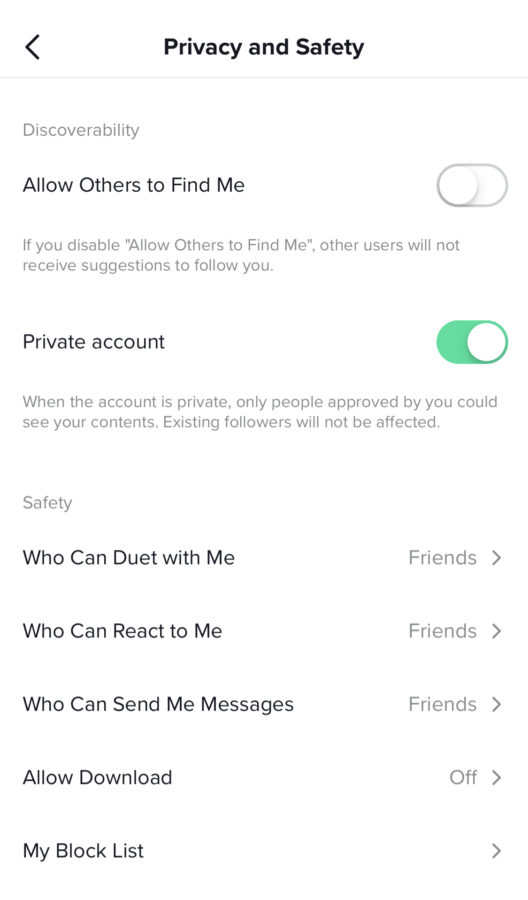
If a user posts their video publically the video can then be remixed, shared or commented on by others on the app, who may not be friends. The privacy settings (below) determine what visibility the video has and who can interact with the user or the video.


So what’s different?

  1. More special effects and interactive features
  2. Broader focus, not just dance and lip sync
  3. More challenges and dares, themed skits and pranks
  4. More interaction and collaboration on videos
  5. Broader demographic – more adults are making videos
  6. Live video streaming more prominent


Adult Content

Some content in the videos is very mature. I’ve seen videos with self-harm themes, drug and alcohol use, explicit sexual references, explicit language and lyrics, and dangerous behaviour. This adult content is easily found by simply scrolling through the “For You” feed.


Sexualised Children

There are many videos of children miming songs with explicit sexual adult language and behaving in sexualised ways.


Bullying

Bullying is still a big issue, with harassment in the comments and parody videos being created to humiliate and tease some users, particularly users with disabilities. There are quite a few videos from users calling out the bullies also.


Self Harm

Although many of the better known and more obvious hashtag search terms are hidden now, new variations of the #hashtags are created daily. I saw a lot of videos around the theme of loneliness, self-harm, and depression. I also saw some comments where people were encouraging self-harm.


Young Users

Although there seems to be an increase in adults creating videos on this app, many younger children are still using the app below the recommended age. I’ve seen children that look as young as seven years of age posting videos publicly.


In-App Purchases

Users can purchase “gifts” to give to other users. These range in price from $5.00 right up to $50.00. Popular TikTok “stars” can earn quite a bit of money through gifts. Parents can disable In-App purchases on their child’s device through parental controls which should block any monitory purchases within the app. Go to the “Screentime” settings if on an Apple device.


Adult Predators and Grooming Of Children

The live streaming side of this app has a risk of users being subjected to inappropriate comments and requests in real time. Users who are inappropriate can be reported and banned from the app or from streaming. Because live streaming is interactive, it is not advisable for younger users to live stream.


Setting up Privacy and Safety Settings – How to:

Teens should set their account to a private account and not share their videos publicly to protect themselves.

To find the privacy and safety settings go to your profile and click the … icon top right of the screen. Then scroll down to “Privacy and Safety” Set “Private Account” to the Green/On position.

You can also restrict who you can interact with you on the app via messaging or responses to your videos, set to “Friends”, or switch to “Off”.

Downloading your videos should be disabled also in the settings. Note: This setting may not prevent saving and sharing of your videos. It is relatively easy to copy videos with other screen recording methods. Making sure that all your videos are respectful and appropriate is essential.

Why TikTok is not a place for Tweens

A Safe Profile!

TikTok warns that even with a private account “your profile information – including profile photo, username, and bio – will be visible to all users. You can be sure your profile is online-ready by editing your profile page”. Please do not include personal information such as your real age, real name, school, or a link or user name for other platforms in your profile.


Adult Content Filters and Screen Time Issues

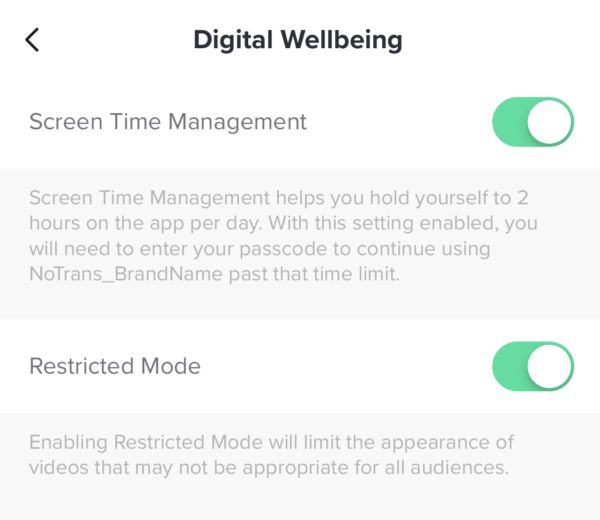
There is now a setting called “Digital Wellbeing” which can be locked with a passcode by a parent. The “Digital Wellbeing” tab has two settings, one to filter adult content “Restricted Mode”  and the other setting to restrict the time on the app to 2 hours a day “Screen Time Management”.

Why TikTok is not a place for Tweens

I tested the “Restricted Mode” for adult content, and it didn’t seem to filter adult content efficiently. I still saw videos with adult content, explicit language and inappropriate behaviour with the filter enabled. From the TikTok Safety Tools Page “Enabling Restricted Mode is an option at the account settings level to limit the appearance of content that may not be appropriate for all audiences.”

Scrolling through the videos, even with the “Restricted Mode” on it is still very easy to come across adult content with, swearing, bullying, dangerous behaviour, and sexual themes. This setting is unreliable.


Screentime Setting Management – To Limit Time On The App:

There is also a new screentime limit setting to help users limit their time on the app. “With Screen Time Management enabled, we’ll help hold you to 2 hours on the app.” As a parent, you could lock it on with a secret pin code. The app will then lock up and ask for the parent’s pin code when use has reached 2 hours. There is no way to change the time limit so that it will lock up under 2 hours.


Sharing profiles across social media.

Users can share their profile to cross-promote it across to other platforms like Facebook, WhatsApp, Snapchat and Instagram. It is safer not to do this.


Last thought – Why TikTok is not a place for Tweens

The app is rated 16+ by Commonsense Media, although the app is rated on iTunes at 13+ I would agree with Commonsense Media’s assessment of 16+ preferably 13+ minimum depending on the maturity of the teen. This is due to the adult content, self-harm themes in some videos, frequent bullying, live streaming interactivity and the social side of the app. The privacy settings need to be enabled for teens and younger children, but there is no way to lock them on. Use of this app takes a mature person who can deal with bullying, possible sharing of their videos beyond their friends and inappropriate comments, random friend requests, and explicit language and adult themes.


Verdict: Definitely NOT for the under 13’s. Recommended age 16+


Leonie Smith, “The Cyber Safety Lady”, is one of Australia’s leading Online Safety Educators. She travels around Australia, helping thousands of internet users to use the internet with more safety. Her manual, “Keeping Kids Safe Online” provides a unique Step-By-Step and up to date guide, for cyber safety settings and education.

If you would like more, Leonie is hosting a “Keeping Kids Safe Online” Webinar on Tuesday 10th March 2020 8pm Sydney Time. This is a one hour webinar for parents with insights into the latest apps including TikTok, Snapchat, Instagram, games like Fortnite and Roblox.


Additional Legal News on TikTok, from Leonie

The Chinese owners of this app ByteDance have been fined a record $5.8 Million US dollars (8 million Aus) by the U.S Federal Trade Commission for not complying with the Privacy Protection law COPPA. The reasons for the fine are that TikTok did not adhere to the law in protecting users under the age of 13+. They did not ask for age verification prior to 2017 on sign up or take down profiles of underage users who clearly stated their age on their public bios. They did not respond to parents requests to delete under age user videos and personal information. They also exposed children to predatory behaviour on the app and up until 2016 exposed users privacy giving their location within an 80K radius.

This has resulted in TikTok having to adhere to some new restrictions for U.S users. They have been told to take down U.S underage user accounts, to ask for age verification on sign up, and direct underage users to a safer version of the TikTok Platform. They must now also remove the videos of users when requested from the database. These restrictions will not cover any children based outside of the U.S. Australian children are not covered by this COPPA ruling. You can read more about the ruling and what it means here 


An Open Letter to Secondary Students

By Sharon Witt
An Open Letter to Secondary Students

Image by: freestocks.org

An open letter to Secondary Students, from Author, Teacher and Speaker, Sharon Witt, who has written on Starting Secondary School, on my blog before.


This letter is addressed to students in Melbourne, Victoria. However, so much of this is true for Secondary Students and Final Year students anywhere in Australia this term.


What a year they have come through. We are so proud of them!


“Dear Secondary Student,


This week is the time you have been anticipating for many months – returning to school after what seems like forever.


It has been a long road. You have been patiently waiting for your turn to head back to campus, always in the back of your mind that a further announcement at any minute could spell the completion of your schooling this year from home.


You have missed so much. Within a very short time, many of the things that brought you joy – your sporting practice, footy matches, Drama group, shopping, going to see a movie, hanging out with friends and mates at the park- all of your social activities, could no longer occur as our state battled to control an invisible enemy known as Covid19.


As you wake today, dust off that schoolbag and clean out your lunchbox (is that a mouldy sandwich you just found?!). You may be feeling anxious or really excited to be amongst your peers in real life today (as opposed to small faces on a screen for months on end.)


I know that for many, you are feeling like being in ‘remote learning’ during a world-wide pandemic has made you fall behind in your learning. You wonder if you’ve fallen so behind in your work as it seems everyone else has been navigating online learning quite easily. You fear that you have learnt so little in the past 6 months.


But what if I asked you to reframe this experience?


What if I reassured you that you have, in fact, learnt a great deal more during this unprecedented time off ‘more formalized, on campus learning’?


You see, learning doesn’t just take place within the fences of a school campus; the four walls of a classroom. What if I assured you, that you have in fact, learnt a great deal more in these past 6 months than you may have otherwise, and you may be, in fact have become a better equipped, young person, who has learnt so much more than you could possibly realise.


You have learnt a great deal of resilience over the past 6 months.

That there will be situations and events in life that can catch us off guard at any time, that we were not prepared for, and we have to learn to adapt, use the resources around us (family, friends, teachers) and those within us, to manage and cope.


You may have learnt about the use of online technology in learning in a way you haven’t had to use before. Your teachers have certainly had to adjust very quickly, and many of you helped some of your exasperated teachers work out how to ‘share their screen’ or ‘access the chat option’ in the initial weeks. Be assured, your teachers have had to learn on the run too!


You may not have understood all the math concepts during remote learning, but you have learnt a lot more about yourself. You learn more effectively in the afternoon, rather than the mornings. You have learnt that you need to put specific goals in place to be motivated to complete on-line assessments.

You may have learnt that you enjoy more time on your own, to read, write, create, learn an instrument. Maybe you learnt how to cook, write songs, build, plant, and dream.


You have learnt that you really thrive best around people. You have had to learn different ways of meeting your needs of connection with others- whether that be facetiming your friends, playing online games together from the comfort of your own homes, writing actual letters and cards to your grandparents and posting them.


You have learnt perhaps, even more-so the value of family. Of creating new traditions, like walking or riding as a family, movie nights with pizza, discovering a new competitiveness when playing family board games, the joy of caring for and looking out for neighbours or those most vulnerable within your community.


You have most definitely learned more about epidemiology (even if you don’t know how to spell the word!)- how a seemingly simple virus can threaten not only our health,  but affect your community and country in ways that we will continue to see for perhaps decades.


You have learnt how state versus federal politics work. How a state leader relies on other professionals to make important daily decisions that then affect our everyday lives.


So, as you head into school this week, may you reframe the significance of today.


You have not fallen behind – you are exactly where you are meant to be. In fact, you are much stronger, wiser and resilient that you may have realised.


And remember this – your teachers are nervous too. It has been a long six months for them as they have navigated remote teaching whilst also perhaps caring for their much older parents, other vulnerable relatives, young children, helping their own kids at home learning whilst doing their very best to manage their classes for you. They too have had to learn to put their own coping mechanisms in place when they can no longer go out, visit friends, travel for school holidays, and make plans.


As you enter those school gates this week – whether you are feeling anxious, nervous or just plain excited- remember to use grace. Everyone is in the same boat. You have all experienced a (hopefully) once in a lifetime event.


You will learn from this and have grown through this.

Look out for those that may seem anxious today – those who may have forgotten how difficult it was to socialise with others. Those that actually might have preferred to stay at home to continue their formal learning because the classroom noise and activity can be so overwhelming for them.


Have patience for your peers, and your teachers. They may need a few extra coffees to get used to managing the extra noise and energy in the classroom again. There is no ‘mute’ button anymore. Your teachers are beyond excited to welcome you back to school. They too have learnt so much over these many months of lockdown.

Enjoy being back at school. This term will be over quicker than you know it.

And from your parents and teachers – we think you are amazing!”


Sharon Witt is a secondary educator of over 28 years and author of 12 books for children and teens including ‘Surviving High School’ (for children) and ‘Starting Secondary School’ (for parents), which is co-authored with Dr Michael-Carr-Gregg. You can find out more at www.sharonwitt.com.au

Preparing for Secondary School (for parents)

Pin It on Pinterest